Wednesday, August 08, 2007

Surfing The Kondratieff Wave

Here is An Article I wrote 5/8/06, I thought it worth repeating.

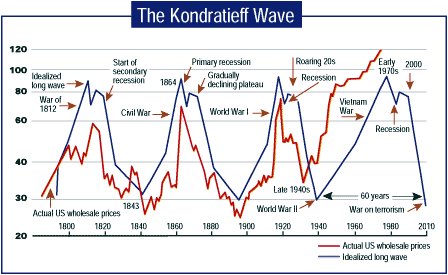
If you're into investment cycles and charts, the Kondratieff Wave is one to examine. Basically the boom and bust cycle had a 60 year span. Here is a link to more detail http://www.kwaves.com/kond_overview.htm Credit the picture above from this link.

The cycle this time around is a little long in the tooth. There is a reason for this and I believe as do some others, that it has to do with the increase in the length of the average persons life span.It use to be about 60 years now we are up to about 75 years.

Each generation has a group of elders that can draw from past mistakes. We are at a point right now, that the follies of the 1920's and 1930's are not part of our "group memory" any more. Most people from that era would be at least 100 years old now. Now when you quote some historical aspect a cause of the last depression, you hear the phrase,"Its different this time."

People today think that the interest only no money down mortgage is something new. Well it isn't. They were written right up to the collapse in 1929. The banks soon realized that it was like the neighbor taking out your daughter for a "test drive" before he married her. The responsibility factor was missing.

Cycles are usually displayed as circles that would follow through phases and complete back where they started. I think that this is not a true analogy of what is happening here. If you start with a spiral going out from the center, this more correctly displays "history repeating itself." It s not quite the same, things have changed somewhat.

People are consuming more and more, and with that, comes the creation of more debt. It is this debt that will be marked to market. Mr. Kondratieff's theory suggests that all of this debt will disappear and the money supply will contract accordingly (drastically in this case).

I don't think that people fully realize how money disappears. Take Lucent Technologies a few years back. It sold for $80 per share and went down to $2. Somebody owned it the whole way down.

What really scares me today, is the people with savings and retirement funds, they have been funding this whole thing. The market will always go up (believe that and I'll tell you another). The trouble is, a majority of the owners of wealth, are going to want to get out of the market pretty soon and they are at the head of the line-- the baby boomer's.The baby boomer's think that this will be a relaxing walk into retirement. More likely its going to be one hell of a panic. If Mr Kondratieff is right, there will be a drastic contraction of the money supply because of the debt marked to market, and because of this, commodities should fall in price.

My question is this. If the world population has increased 4 times in the last 60 years and most of these governments have been printing money at a very vigorous rate, can gold and silver still be considered commodities? I think that they reside outside the realm of consumables.

Saturday, August 04, 2007

The Jim Cramer Implosion

I watched the Jim Cramer of Mad Money melt down on CNBC Friday. Here is a Link to it. He wants Bernenke to lower the interest rates. It was kind of a toss up as to whether it was an act or not. You wouldn’t normally pull stuff like that with people you work with on a daily basis. I don’t think that Erin Burnett who was interviewing him was enjoying the loss of control. I am sure that she thought he deserved a kick in the nuts.

Today on Bloomberg Jim Rogers was interviewed and he referred to the auto industry, the housing industry and the finance industry as being in a recession. He had to correct himself when he tried to pronounce “recession” with a “d,” on two occasions. Just maybe it’s time to pass out the life jackets.

Jim Cramer seems to think that lowering the discount rate is going to save the market. In his way of thinking it will save the market. It will save the quid pro quo. I think we are tired of the salesmanship of, “If this erection lasts more than 4 hours. . . .” In reality we have a stock market that is out of control, we need a meltdown to restore reality. Google alone is pumped up on steroids.

On a good note, we have Wells Fargo raising the Jumbo rate to 8%. This for once seems like a realistic rate for long term home loans. It’s not that I wouldn’t like them lower; it’s the spread between short term and long term that has now gotten healthy. There is now a premium for investing long term that wasn’t present in the past. Things are starting to make sense now.

Bear Sterns is still in control of seating arrangements on the Titanic—I think they are going to move the band to the back of the boat, everyone loves music. It will surprise the people coming back from the life boat tour of the iceberg.

Doomed October Real Estate Figures

June 21, Bear Sterns hit a brick wall. In the last 6 weeks, the real estate finance markets have tightened up. No more easy loans. Home owners are looking at June Housing figures which are 30 days behind today’s date and the purchase date is 30 to 90 days behind that. These homes went into escrow 8 to 16 weeks ago and have been in the sold category for less than 4 weeks.

Notice one thing, the effect of the new lending standards has not even shown up in the real estate statistics. Even if we did a 30 day escrow, the June 21 contract signing would not show up in statistics until September 1. So in effect real numbers for the new lending criteria will not show their effect until October 1, or later (30 to 90 days from now).

If we examine this more minutely, you find that the home owner trying to sell is three months behind the curve. The newspaper figures for home values are a tad bit stale. The number of house sellers has increased, and the people that qualify as buyers have decreased considerably.

The October housing statistics should start to reflect the new lending standards. I would expect to see a very substantial drop in home purchases in San Diego. A lot of people won’t be able to qualify for a home loan. They don’t earn enough to afford the monthly payments; of course that fact didn’t seem to bother anyone a month ago.

Now as of last night, Wells Fargo has announced that its Jumbo rate has now jumped to 8%. So now you can buy a McMansion and they will super size your interest rate (what a deal!). This is a take out order; the current seller gets his lunch and a free ride to the poor house without lifting a finger. Notice that the words “free” and “lunch” were not next to each other.

Friday, August 03, 2007

It Friday

I'm still working on a couple of things. Nothing ready to publish. Dr Housing Bubble has a nice piece to read today you might want to give it a click
Link

It's a letter from a lawyer from the 1930's dealing with farm foreclosures.

Monday, July 30, 2007

Housing Death Knell for the Economy

Between January, 2005 and today, 16 million houses have been sold. Let's figure that the new owner probably paid double of what is was worth. So a 100k to 300k house was purchased for 200k to 600k. Figure that the new market price averages out to 300k.

Multiply 16 million homes by 300k and you end up with 4.8 trillion dollars worth of homes that have mortgages with less than desirable collateral. The owner paid too much and is struggling to hang on. So 50% of that total is about 2.4 trillion dollars. This was money added to the economy that no one had to work for, AKA bubble money.

In the past, the yearly appreciation of the home meant that the money extracted never had to be repaid. Now, the house has ceased to appreciate in value. To the over extended home owner, this change of the rules is just not logical. Everyone knows that housing always appreciates.

The US census lists the total number of housing units in the United States as 125 million as of 2005. How much equity was pulled out of all of the remaining units (125-16=109 million)? You really don’t know where to even start. We could double what was calculated for the 16 million homes purchased and call that an estimate of what the housing owners extracted from their new found equity. That would put the amount of bubble money introduced into the economy at 5 trillion dollars. This money flowing into the economy has stopped. Coincidently, the total United States budget for the last 2 & ½ years was also 5 trillion dollars.

When you realize that the last time we had something this bad in the housing market, it took 5 years to get where we are at now, and we’ve done this all in one year. Talk about over achievers, we’ve outdone ourselves!

The economy is what will be hit and hit hard. It may take time, but what is about to happen, is now more than obvious.

On the lighter side, here is some good news; Congress is going to pass a law to double the number of feet in a mile from 5,280 to 10,560. This will cut our distance to work by half thus decreasing gas consumption by 50%, God bless them!

Sunday, July 29, 2007

The Impeding Hangover

I’ve watched the stock market since about 1958. I was about 12 at the time and my grandfather would take me down to the brokerage office and we would watch the stock ticker print out a never ending trail of letters and numbers. One tape printed on a transparent ticker tape which was projected onto a screen and the other was on a regular ticker tape. Now and then one of the workers would tear off about 3 feet of the regular tape and go up to a 10 X 40 foot chalk board and update the quotes. There was seating for about 50 people, and most were as old as my grandfather. The thing I liked was that the workers would give me the short rolls of unused tape to play with. That was my entertainment from 1 to 4 PM.

Later on in the 60’s and 70’s I watched my father and his stock investments. He even formed an investment club that a lot of the neighbors joined. As an investment group they could afford to buy 100 shares of a stock. Remember wages were about $8,000 per year. The investment group deteriorated over time, people just didn’t have the money or they moved away. It was not the road to riches, it was boring.

A bear market started in 1974 that did some damage, but it didn’t really affect the general population (the DJIA went to 607). It affected the rich and the well to do, their net worth dropped considerably.

I got into the market about 1982. The DJIA was about 1100. My broker had a sign on his desk saying “DOW 2000.” It was always good for a chuckle; everyone was hoping that it would happen, we just didn’t know when.

The people making money were the stock brokers. A typical buy or sell transaction on 100 shares was about a $300 dollar commission. A round trip on one stock would cost you $600. It had to go up at least 6 points to break even. There was an additional $35 dollar charge for an odd lot sale of less than 100 shares

In 1985 I started using a discount broker. Round trip on 100 shares dropped to $220 which wasn’t too bad. Plus, everything was going up. Then, the real discount brokers came online with the advent of internet trading. From there, everyone piled into the market. 20 years ago dropping a stock name at a party would have gotten you a blank stare. Today, everyone talks stocks.

There has been no time since 1929 that we have had this percentage of people in the market that know utterly nothing about what they are doing. The Jim Cramer Stock Show has got to be an indicator of a market top (we are all going to get rich). They’re having fun, no need to spoil the party. Have another drink.

The bears are restless, this could be the week.

FYI, the DJIA circuit breaker that would close the market for the rest of the day is now 4,050 points. It’s nice to know that any future stock market panic has been well thought out. So if you feel like jumping, pick a ledge and grab a number.

Sunday, July 22, 2007

The 1930’s Era Housing Auctions Are Back

In today’s San Diego Tribune, there is a ¾ page ad titled "Lender Foreclosed Public Home Auction." USHomeAuction is holding three auctions, one in San Diego, one in Ontario and one in Los Angeles. 480 homes are listed for bid in the sale. Here is a link to their homepage

The listings are for condos and single family homes. Starting bids are about 50% of the previous value which doesn’t sound bad. Bear in mind, this is just the beginning of housing auctions.

As an auction pricing guide, I would suggest that you calculate single family homes for $80 per square foot and condos for around $35. The only reason I picked these two prices, is that you can’t build a new unit for that, you are below the contractor's cost of construction.

I can remember back when you couldn’t even sell a mobile home in Las Vegas, because condo's were even cheaper. Then there was the real estate collapse during the oil boom years in Texas. At auction, you could put a 1,000 sq ft home, on your Visa card.

It will be interesting to see if they sell the whole slate. Rumor has it that a new real estate appraisers hand book is out, titled "Up in Smoke." They are promoting it with a free gallon of tar and a bag of feathers.

St Joseph the House Saint

We went garage sale hunting yesterday. My wife and I cruised our weekly route around the San Marcos Vista area. There were quite a few garage sales and we couldn’t help but notice a lot of for sale signs (I picked up a real nice rice cooker for $2).

We stopped in an over 55 community in Vista. Houses in that area are going for 270K to 300K (1,200 sq ft). The owners are quoting these prices with a straight face. I just can’t believe it, the houses are “Tear Downs."

In a nicer section built before Mello Roos, there were three in a row for sale, all for between 525K and 619K (The one with the dead lawn was definitely an REO).

Then over in our area, there were three houses looking at each other 550K to 650K. All three have Mello Roos payments besides taxes. One was a “Help You Sell” another was a “For Sale by Owner,” and the last was a Realtor listing. It sure is great to be able to park your car and look at three listings facing each other, it saves all of that driving around!

A lot of people have been suggesting that the real estate bubble has popped. For this area, I tend to doubt it. The owners have no concept of current market conditions. They bought it for 600K and by golly they are going to sell it for 600K.

On one hand, we have the owners who have extracted their equity and bought new cars, vacations, breast augmentations, and what ever. On the other, you have people that didn’t get on the wagon, they missed the boat. They don’t have the bills, but they have no exotic toys either. My wife has classified us as being in the latter group, and it’s all my fault. And of course, we know the wife is always right, cough, cough.

This bubble seems to be bursting from the outside in. The financial institutions have stopped offering the 2/28 and 3/27 loans (It was kind of like using a Bic lighter to trim your nose hairs. It worked great, but you won’t do it again). The time lag right now seems to hang on property appraisals. Housing prices are still far from what many would consider realistic.

Your typical home owner believes their homes will sell, it’s just going to take a lot longer than they anticipated, times are tough (the sign of a real plugger). The rising median home price will confirm the owner’s perception that home prices are rising, when in actuality, it’s an indicator that the lower price houses are just not selling.

Right now in this area, it looks like we are in a lateral shift, a waiting game. Nobody wants to buy at these prices and no one wants to sell for less than what they bought for. The monthly mortgage payment will bring reality back (once every 30 days). Your 2/28 is going to turn into a 24/7 headache. I wonder if that’s what St Joseph’s Aspirin is for--house headaches.

Tuesday, July 17, 2007

Bear Sterns "Dropped" a Zero

Quoting from this blog three weeks ago "Hedge Fund Meltdown" June 21

".........So, April means a June withdrawal, and June means a September 1 withdrawal. These two funds are toast, but it’s going to take a while. Look’s like there is 15 to 20 billion to unwind here."

It's kind of a moot point now, since there is nothing left to withdraw.

At first they were ready to jump in with 3.2 billion. A question runs through my mind. How much is in play? I would guess 10 to 20 times the amount offered.

The Bear Sterns Fund loss could be considerably bigger. From what can be read, the total loss appears to be around 1.5 billion dollars. So when you show up with 3.2 billion to begin with, it makes you wonder.

It's kind of like when your wife buys you a new car (don't hold your breath). Whose pocket did it really come out of? The wife writes a check, the husband has the job. Then to carry it one step further, the car she bought is a Lamborghini.

When you get to this point, you have to realize that the focus of Bear Sterns is damage control. Nobody is going to wheel in that much money to prop up something unless there is a chance of a salvaging the situation. Plus where did the money come from?????? And if that isn't obvious, well, we won't go there.

This country was settled with people that voted with their feet. Sadly with Bear Sterns, people will still vote with their feet.

There is a zero missing, it just isn't that apparent yet. The real problem, is that its on the left hand side of the decimal point, not the right.

Monday, July 16, 2007

Possible Bear Trap Squeeze

June 29, I wrote a little piece "Harvesting the Shorts." I pointed at KB Homes as a target. It might just be in the works for this week, only the stock chosen has changed.

Notice how last week the rumor, of Warren Buffett buying Hovnanian Homes, got set off with the purchase of a lot of, "out of the money" calls?

There are 62 million shares of Hovnanian Enterprises outstanding and 34 million in the public float. The June 15, WSJ short position for HOV was 18.6 million. This looks like a full blown bear trap. Somebody seems to be following my outline.

If a bunch of wealthy people got together and tried to squeeze the shorts, they would end up like Martha Stewart. Now if they formed a Hedged Fund LLC. . . Hmmmmm.

There was one bear trap back in 1929 that was very successful, I can't remember the name of the stock. I think the stock was halted when it hit $700, but the shorts ended up settling for $100 per share (they were let off rather easy).

Nah, I guess it's my imagination acting up again, but it looks so obvious, I just can't help myself. I can be wrong once in a while, can't I??