There are housing bubbles all over the world, stock speculation at absurd levels, hedge funds and derivatives way out of whack. The question arises; what will convince everyone that the game is over?
Here is where it gets tricky. The common denominator of all the different parts is "Interest Rates." The trigger could very well be a panic in the bond market.
What people don't realize is, markets create interest rates. Governments can tweak them for a month or two, but they will come back to some desired level totally irrelevant of government prodding.
The Second Trust Deed Market is very vulnerable, a lot of that stuff was written with 7.5% rates. So lets say a dealer has a $100,000 second that he needs to unload, because the real estate market looks bad. So if he discounts the note to a face value of $50,000 it will pay an equivalent 15% interest. At this point there doesn't seem to be much damage, right?? Wrong!
Suppose you had a 30 Bond for 100,000 paying 5%. After that transaction, with an interest rate payout of 15% you could only sell it for 1/3 of its face amount.
The fundamental not realized, is that bonds have not had this low an interest rate in 45 years. So for a $100,000 thirty year bond at 5% to double in price, the interest rate would have to drop to 2.5%. That's not very realistic. But if we pursue the idea the other way, the same bond would be worth only $25,000 if the interest rate jumped to 20%. It would loose 3/4th of its value. Now that's not to say that you couldn't wait around 30 years and collect the face amount of the bond 100,000. I'd be almost 90 years old, so its not realistic.
Plus lets work it from the disaster end. If the interest rate were to jump to 20% you would buy the 30 year bonds paying 20% interest. Or you could buy the old 100,000 bonds paying 5% marked to market at $25,000 (what a deal if you live to be 90)!!! So at that point, if the interest rate dropped from 20% to 10% your bond face value would double. Not bad for a bond, plus you get the interest accrued.
So what is transpiring, is a contraction of actual assets. A doubling of the interest rate in the bond market can literally contract the money supply by 50%. It could from there double again without so much as the of a blink of an eye.
At this point, the hedge fund and derivatives managers would be in a melt down mode. This might seem illogical, but I suggest that these managers, might be invested in something like Google up to the hilt, and at the same time with options and derivatives satisfying their customers asset allocation directives.
Translated into layman's terms, the bond market will have a bad day, and the stock market will have an even worse one. After that, the housing market will have to deal with reality. The party is over.
Friday, July 14, 2006


Wednesday, July 12, 2006
The Contraction of Liquidity
If you'll notice, most major world markets are on a downward trek, the trend is not up.
Couple that with house prices, they are starting to trend down. Not fast, but the direction has changed from up to down. The amount of inventory has raise quite a few eyebrows. Nobody is launching the lifeboats so everything must be OK.
Long term interest rates have been rising very slowly with no appreciable effect on installment purchases. A rather peculiar side effect considering everything else. A $5,000 liquid plasma TV is only a signature away, no payments for one year.
Want a BMW? "Well, do we have a deal for you!" It makes you wonder where the money is coming from to pay for all of this. The fact is, the money is not there to loan unless the lending standards are lowered.
When you visualize a bankruptcy or a foreclosure, the time it took to get that point doesn't enter into the equation. It takes about a year.
So where are we now? I believe that this is the beginning of "That Year." Layoffs will follow from here. The stock market seems to be in the doldrums. The bond market is stuck between a rock and a hard place. With all of the bad paper out there, it can't go any lower, and if you have a 30 year bond at 5%, you're going to loose big time.
The smart money is going to T-bills. I wonder, if you purchase a T-bill over 100,000, would it show up on the M3 money supply total that has been discontinued? That might be why they discontinued reporting the value. Big money might be bailing out of regular bank deposits. The government very rarely fires bean counters, and to discontinue the M3 money supply report, suggests that the reasoning could have been very well thought out.
Couple that with house prices, they are starting to trend down. Not fast, but the direction has changed from up to down. The amount of inventory has raise quite a few eyebrows. Nobody is launching the lifeboats so everything must be OK.
Long term interest rates have been rising very slowly with no appreciable effect on installment purchases. A rather peculiar side effect considering everything else. A $5,000 liquid plasma TV is only a signature away, no payments for one year.
Want a BMW? "Well, do we have a deal for you!" It makes you wonder where the money is coming from to pay for all of this. The fact is, the money is not there to loan unless the lending standards are lowered.
When you visualize a bankruptcy or a foreclosure, the time it took to get that point doesn't enter into the equation. It takes about a year.
So where are we now? I believe that this is the beginning of "That Year." Layoffs will follow from here. The stock market seems to be in the doldrums. The bond market is stuck between a rock and a hard place. With all of the bad paper out there, it can't go any lower, and if you have a 30 year bond at 5%, you're going to loose big time.
The smart money is going to T-bills. I wonder, if you purchase a T-bill over 100,000, would it show up on the M3 money supply total that has been discontinued? That might be why they discontinued reporting the value. Big money might be bailing out of regular bank deposits. The government very rarely fires bean counters, and to discontinue the M3 money supply report, suggests that the reasoning could have been very well thought out.
Sunday, July 09, 2006
The Social Security Morass
F.D.Roosevelt got Social Security going during the Great depression. If you examine the original idea, it wasn't too bad, only about 5% of the population would ever live to collect it. Now over 60% of the population will live to "collect" it.
The Social Security tax is supposed to be deposited into a trust fund. To make the story simple, The Congress has written some IOU's and spent the money. Someone complained about this abuse and the Supreme Court ruled that the Social Security tax was just that, a TAX and the government could do whatever it wished with it.
Did I mention the word Medicare? I know I didn't mention "800 pound gorilla." Why worry about Social Security, that's a nickel and dime game compared to Medicare.
There is another one called SSI (Supplemental Security Income). You can draw this if your Social Security check is below poverty minimums. A lot of immigrants in this country legally over the age of 65 qualify for this payment even if they have never worked a day in their life. These people are also eligible for Medicare. Imagine, a foreigner can qualify for a retirement pension of about $580/month with free medical, not bad!
What we are looking at here is an item called Transfer Payments. The money spent is spent on consumption. There is no investment in new enterprises. This money for lack of a better word is being confiscated from your children before they have even earned it. There is no perceived budget amount set aside for these future expenditures. Its pay as you go.
We are at a fork in the road, similar to the 1930's. Germany decided to inflate and ruined anyone that had a bank account. The US survived with deflation and ruined almost everyone with a bank account.
The real question is; how much time do we have to enjoy these "retirement benefits?" Hint: there is no tooth fairy.
The Social Security tax is supposed to be deposited into a trust fund. To make the story simple, The Congress has written some IOU's and spent the money. Someone complained about this abuse and the Supreme Court ruled that the Social Security tax was just that, a TAX and the government could do whatever it wished with it.
Did I mention the word Medicare? I know I didn't mention "800 pound gorilla." Why worry about Social Security, that's a nickel and dime game compared to Medicare.
There is another one called SSI (Supplemental Security Income). You can draw this if your Social Security check is below poverty minimums. A lot of immigrants in this country legally over the age of 65 qualify for this payment even if they have never worked a day in their life. These people are also eligible for Medicare. Imagine, a foreigner can qualify for a retirement pension of about $580/month with free medical, not bad!
What we are looking at here is an item called Transfer Payments. The money spent is spent on consumption. There is no investment in new enterprises. This money for lack of a better word is being confiscated from your children before they have even earned it. There is no perceived budget amount set aside for these future expenditures. Its pay as you go.
We are at a fork in the road, similar to the 1930's. Germany decided to inflate and ruined anyone that had a bank account. The US survived with deflation and ruined almost everyone with a bank account.
The real question is; how much time do we have to enjoy these "retirement benefits?" Hint: there is no tooth fairy.
Saturday, July 08, 2006
Thirty year vs Three month Interest Rates
The Fed has raised the interest rate 17 times and the 30 year yield has gone up 2/3's of a point. The three month T-bill has jumped up in locked step with the Fed. The curve between the 3 month and the 30 year is so damn flat that you almost have to throw in the "F" word to explain how flat.
As far as the bond market is concerned, there is no extra value being demanded for long term bonds verse short term bonds. There is no reflected risk of investment. There is no perceived long term risk as there should be. What happens if 3 million homeowners default on their 30 year mortgages? At some point, note holders will be discounting loan notes to make them attractive to other investors. Long term interest rates could zoom to 20%. A thirty year note written at %5 marked to 20% is a 75% loss (you could wait 30 years and get your principle back).
Why are interest rates so low for housing? Common sense demands that you charge more for a 30 year rate than a five year rate. More can go wrong in 30 years. The words "Government Sponsored Enterprise," (GSE) like Fannie Mae or Freddie Mac come to mind. These two GSE's, through options and hedges, have "taken" the risk out of investing. Another acronym you'll hear is "MSB," "Mortgage Based Security's." It kind of reminds me of spelling out a word so you're little brother won't catch on. The next time you hear a Congressman talk about investigating the GSE's in regard to MSB's, your eyes won't gloss over anymore, you'll run for the exit!
There is a point however, when people will demand more interest for greater risk. At that point, we enter the real world.
In 1929, the Fed raised the interest rates until the stock market crashed. In today's world, the Fed is kind of like a hunter shooting at a sound in the brush. At this point, we know they hit something; we're just not sure what it is!
As far as the bond market is concerned, there is no extra value being demanded for long term bonds verse short term bonds. There is no reflected risk of investment. There is no perceived long term risk as there should be. What happens if 3 million homeowners default on their 30 year mortgages? At some point, note holders will be discounting loan notes to make them attractive to other investors. Long term interest rates could zoom to 20%. A thirty year note written at %5 marked to 20% is a 75% loss (you could wait 30 years and get your principle back).
Why are interest rates so low for housing? Common sense demands that you charge more for a 30 year rate than a five year rate. More can go wrong in 30 years. The words "Government Sponsored Enterprise," (GSE) like Fannie Mae or Freddie Mac come to mind. These two GSE's, through options and hedges, have "taken" the risk out of investing. Another acronym you'll hear is "MSB," "Mortgage Based Security's." It kind of reminds me of spelling out a word so you're little brother won't catch on. The next time you hear a Congressman talk about investigating the GSE's in regard to MSB's, your eyes won't gloss over anymore, you'll run for the exit!
There is a point however, when people will demand more interest for greater risk. At that point, we enter the real world.
In 1929, the Fed raised the interest rates until the stock market crashed. In today's world, the Fed is kind of like a hunter shooting at a sound in the brush. At this point, we know they hit something; we're just not sure what it is!
Wednesday, July 05, 2006
The Million Dollar Land Grab
When it comes to land, there is no real concept of value that is rational, when you apply it to real estate.
Let’s take farmland; $5,000 per acre with water rights will allow a good return to a farmer. Right now, a farmer would have to clear over $325 per acre in order to have a better return than interest income on the same amount ($5,000) from the bank. An 80 acre farm would net $26,000 per year.
It’s not uncommon for land developers to go into farmland and buy up, say 20 acres. A good market price would be $80,000 per acre.
In California, some of this farmland can fetch 1 to 2 million an acre. The contractor buys the land and then, subdivides it into lots. In some areas, the contractor can literally build 16 houses per acre. That comes out to $62,500 to $125,000 per lot. Now add water sewer, gas etc for lot development and permits, and you would add in about $40,000 per lot. An acre is 43560 square feet. Let’s say 10% of it is road. That leaves 39,000 square feet divided by 16 houses, which equals a lot size of 2,500 feet. The contractor is committed to fixed cost for land of $102,500 to $165,000. Now figure the cost of house construction. The contractor probably can construct a house in a range between $75 to $100 per square foot. If we use 2,500 square feet as an average house, then we have construction costs from $187,500 to $250,000 per unit. Add in the land cost range we used and you get the contractors cost of production between $290,000 and $415,000.
Land-----------$1,000,000 per/Acre----vs--------$2,000,000 per/Acre
Lot Cost----------------62,500------------vs-----------125,000
Development----------40,000------------vs------------40,000
Construction Cost---187,500------------vs-----------250,000
House Cost---------$290,000------------vs---------$415,000
Right now in California, that house is attempting to be sold for $650,000.
Step back for a moment and look at the picture from a different perspective. My figures are rather arbitrary, but examine two groups, the farmers and the builders. The farmer can sell half of his 80 acres for 40 million dollars. The contractor can make $250,000 to $350,000 per lot on the sale side (by the acre, its 4 million to 6 million).
Now, enter the home owner that decides not to sell at these prices and wait for the market to come back. A lot of these houses up for sale are 20 to 30 years old. Who wants to buy and old house when they can buy a brand new one for a lesser amount?
What if I was to tell you, that the house’s cost(my figures), actually included the builder’s profit added in. What if the contractor’s cost per lot dropped $50,000 (in a depressed market).
The farmers selling raw land and the contractor, are not going to stop their business arrangement, their price is determined before the first shovel of dirt is moved. There is an awful lot of money to be made. From farmer to contractor, compare it to a fire storm of immediate wealth.
Does the contractor want the homeowner to hold out for a higher price? You bet he does! He can beat any “used home,” in town at a lower price. He’s in it to make a living; the homeowner is trying to get out alive. The longer “used real estate” prices remain high, the longer the contractor has a “premium” return. A good contractor can’t help but make a profit at these prices, and as prices go down, his land acquiring prices go down.
The one thing that can contradict this is oversupply. More aptly labeled "miss-allocation of resources." The ability to create money at such a fast rate can stimulate an overproduction, which ends in a collapse. The fantastic rate of return and growth in construction real estate, supports the suggestion of an impending collapse of the industry.
As a foot note, I used 16 house per acre, I have lived in an area where it was closer to 20 houses per acre. As for construction costs on condos, which I skipped over, they can be constructed as cheap as $39 per square foot.
Let’s take farmland; $5,000 per acre with water rights will allow a good return to a farmer. Right now, a farmer would have to clear over $325 per acre in order to have a better return than interest income on the same amount ($5,000) from the bank. An 80 acre farm would net $26,000 per year.
It’s not uncommon for land developers to go into farmland and buy up, say 20 acres. A good market price would be $80,000 per acre.
In California, some of this farmland can fetch 1 to 2 million an acre. The contractor buys the land and then, subdivides it into lots. In some areas, the contractor can literally build 16 houses per acre. That comes out to $62,500 to $125,000 per lot. Now add water sewer, gas etc for lot development and permits, and you would add in about $40,000 per lot. An acre is 43560 square feet. Let’s say 10% of it is road. That leaves 39,000 square feet divided by 16 houses, which equals a lot size of 2,500 feet. The contractor is committed to fixed cost for land of $102,500 to $165,000. Now figure the cost of house construction. The contractor probably can construct a house in a range between $75 to $100 per square foot. If we use 2,500 square feet as an average house, then we have construction costs from $187,500 to $250,000 per unit. Add in the land cost range we used and you get the contractors cost of production between $290,000 and $415,000.
Land-----------$1,000,000 per/Acre----vs--------$2,000,000 per/Acre
Lot Cost----------------62,500------------vs-----------125,000
Development----------40,000------------vs------------40,000
Construction Cost---187,500------------vs-----------250,000
House Cost---------$290,000------------vs---------$415,000
Right now in California, that house is attempting to be sold for $650,000.
Step back for a moment and look at the picture from a different perspective. My figures are rather arbitrary, but examine two groups, the farmers and the builders. The farmer can sell half of his 80 acres for 40 million dollars. The contractor can make $250,000 to $350,000 per lot on the sale side (by the acre, its 4 million to 6 million).
Now, enter the home owner that decides not to sell at these prices and wait for the market to come back. A lot of these houses up for sale are 20 to 30 years old. Who wants to buy and old house when they can buy a brand new one for a lesser amount?
What if I was to tell you, that the house’s cost(my figures), actually included the builder’s profit added in. What if the contractor’s cost per lot dropped $50,000 (in a depressed market).
The farmers selling raw land and the contractor, are not going to stop their business arrangement, their price is determined before the first shovel of dirt is moved. There is an awful lot of money to be made. From farmer to contractor, compare it to a fire storm of immediate wealth.
Does the contractor want the homeowner to hold out for a higher price? You bet he does! He can beat any “used home,” in town at a lower price. He’s in it to make a living; the homeowner is trying to get out alive. The longer “used real estate” prices remain high, the longer the contractor has a “premium” return. A good contractor can’t help but make a profit at these prices, and as prices go down, his land acquiring prices go down.
The one thing that can contradict this is oversupply. More aptly labeled "miss-allocation of resources." The ability to create money at such a fast rate can stimulate an overproduction, which ends in a collapse. The fantastic rate of return and growth in construction real estate, supports the suggestion of an impending collapse of the industry.
As a foot note, I used 16 house per acre, I have lived in an area where it was closer to 20 houses per acre. As for construction costs on condos, which I skipped over, they can be constructed as cheap as $39 per square foot.
Thursday, June 29, 2006
Slavery is not Dead
The homeowner that has bought into this real estate mess in the last two years can probably classify him or herself as a slave to the bank, or to whoever owns the note on their house.
Here is a definition of Slavery from Wikipedia:
"Slavery is a condition in which one person, known as a slave, is
under the control of another person, group, organization, or state.
Slavery almost always occurs for the purpose of securing the labor
of the slave. A specific form, known as chattel slavery, is defined
by the absolute legal ownership of a person or persons by another
person or state, including the legal right to buy and sell them just
as one would any common object."
It sounds as if I am being facetious, but think about it. This homeowner is going to pay up to 55% of their income to keep up the house payments. This is after tax income. So add 10% onto the 55% and you get 65% of income spent on the home. Add another 10% for expenses like heat, water, trash electricity and you are up to 75% of their income. This leaves 25% left for enjoyment of living; food, clothes, restaurants, movies, cars, insurance (health, car, life, home) and maybe a payment on their credit card. Add a Home Equity Line of Credit (HELOC) and you could be dead meat!
At this point, you have to ask yourself, can the owner of the contract perform as expected by the bank and everyone else? On an individual case basis, the answer is “maybe,” but homeowners as a group, the answer is “no.”
The concept of slavery, is that someone else will profit from most of the efforts of your labor. The homeowner has no concept of the slavery issue—Lincoln freed the slaves, and buddy, I have news for you. Your Realtor, Bank and Appraiser, found a new way to hook you up to that wagon of serfdom. The real irritating thing is, that you let them help you into the mess, and thanked them for it, to boot!
The new homeowner reading this claims says; "Hey I’m not a slave, I own, I don’t rent." Well, I’ll give you two years before your wife and kids file for divorce and leave you. This satisfies the last part of being a slave, the right to buy and sell the slave. What is not realized is that the wife and kids want more out of life, and it is not happening. Money problems break up most marriages. So your wife leaving is the equivalent of being sold to another owner. Admittedly this is very far fetched, but what the hey, its only a blog!
So remember New Homeowner, slavery is a concept that is invisible, only because everyone else is doing it. When the music stops, they are not taking away one chair, the sad truth is, there will be only one chair left!
The only advice I can give, if you are married, and find yourself in this situation, is to not blame each other. Once you realize that the situation is bad and that mistakes were made, work to a solution together. The most common reflex is to blame someone else for your situation, and this is normal, no one wants to be labeled as a cause of present problems. A divorce is a lose, lose situation and often seems like the easiest route out of the disaster, don’t do it. You are at this point in your life only because several professional people made a lot of money off of you and your family.
Here is a definition of Slavery from Wikipedia:
"Slavery is a condition in which one person, known as a slave, is
under the control of another person, group, organization, or state.
Slavery almost always occurs for the purpose of securing the labor
of the slave. A specific form, known as chattel slavery, is defined
by the absolute legal ownership of a person or persons by another
person or state, including the legal right to buy and sell them just
as one would any common object."
It sounds as if I am being facetious, but think about it. This homeowner is going to pay up to 55% of their income to keep up the house payments. This is after tax income. So add 10% onto the 55% and you get 65% of income spent on the home. Add another 10% for expenses like heat, water, trash electricity and you are up to 75% of their income. This leaves 25% left for enjoyment of living; food, clothes, restaurants, movies, cars, insurance (health, car, life, home) and maybe a payment on their credit card. Add a Home Equity Line of Credit (HELOC) and you could be dead meat!
At this point, you have to ask yourself, can the owner of the contract perform as expected by the bank and everyone else? On an individual case basis, the answer is “maybe,” but homeowners as a group, the answer is “no.”
The concept of slavery, is that someone else will profit from most of the efforts of your labor. The homeowner has no concept of the slavery issue—Lincoln freed the slaves, and buddy, I have news for you. Your Realtor, Bank and Appraiser, found a new way to hook you up to that wagon of serfdom. The real irritating thing is, that you let them help you into the mess, and thanked them for it, to boot!
The new homeowner reading this claims says; "Hey I’m not a slave, I own, I don’t rent." Well, I’ll give you two years before your wife and kids file for divorce and leave you. This satisfies the last part of being a slave, the right to buy and sell the slave. What is not realized is that the wife and kids want more out of life, and it is not happening. Money problems break up most marriages. So your wife leaving is the equivalent of being sold to another owner. Admittedly this is very far fetched, but what the hey, its only a blog!
So remember New Homeowner, slavery is a concept that is invisible, only because everyone else is doing it. When the music stops, they are not taking away one chair, the sad truth is, there will be only one chair left!
The only advice I can give, if you are married, and find yourself in this situation, is to not blame each other. Once you realize that the situation is bad and that mistakes were made, work to a solution together. The most common reflex is to blame someone else for your situation, and this is normal, no one wants to be labeled as a cause of present problems. A divorce is a lose, lose situation and often seems like the easiest route out of the disaster, don’t do it. You are at this point in your life only because several professional people made a lot of money off of you and your family.
Sunday, June 25, 2006
The Invisible Derivative's Market
Call it gamblers insurance. The most common derivatives are Puts and Calls. If you think that Google is going to go down and you want to still hold it because of its upside potential you would buy a Put at say $375. So if Google was to drop to $200, you could "put it" to the option seller at $375. The cost of this insurance option varies, depending on the volatility of the stock. Now, if you thought Google was going to go to $1,000 you could purchase a Call at $400 strike price. If the stock rose to $600 you could exercise the Call and get the stock at the $400 dollar price or the difference between the Call price and the current value.
The figures vary somewhat, but about 90% of all options expire worthless in the U.S. Stock Market.
Enter the Gunslinger (slang term for wet behind the ears Mutual Fund trader) (never seen a real bear market in his life---there hasn't been one). This guy gets the bright idea to sell both Puts and Calls. As long as the market lumbers along the guy is raking in the coin.
Say the Dow has a bad day and drops 300 points. It seems like a big move, but since it is a measure of 30 stocks bought in 1910, multiply the 300 point drop in value by the Dow divisor .122834016 and you get a real dollar loss of $36.85 on the Dow. Divide that by the 30 Dow stocks and you get $1.22 per stock. If that were to happen, no big deal pay out to the Puts exercised. Notice, you only get burned on the Puts OR the Calls NOT BOTH in any one point in time. I stress the words "point in time."
The Derivatives Market is bigger than our stock market. One analogy used the comparison of an elephant to a mouse; here is a graph from one source that puts it at 35 trillion dollars.

This graph of the Derivatives Market is from www.gold-eagle.com.
Now suppose the Dow Jones drops 1000 points. Then by some miracle the market comes back to even at lunch time. Then, it soars up 1,000 points by the close. The gunslinger gets hit going down and nailed again when it goes up (the double whammy). He would be selling Calls like crazy while the market is going down trying to recoup losses from his naked Puts, then as the market heads north he gets eaten alive by the Calls he wrote earlier.
We only picked one market; there is the bond market, the commodities market, and foreign exchange markets, to name a few. At this point, the gunslinger is in a situation that looks like the kiddy game, where you have a hammer and hit the head that pops out of one of many different holes. The model turns into a real mess, when you realize that there are thousands of Mutual Fund Managers that will all be playing this game in real time. Naturally these different markets will be doing different things. The word "panic" comes to mind.
My suspicion with Mutual Funds and IRA's, is that when you specify how you want your portfolio invested, they are not moving your money from one investment to another, they are purchasing a derivative to satisfy your demands of asset allocation. This leaves them free to pursue the line of investment they feel most confident with.
So much for "what ifs," the Derivatives Market is a Fantasy Land with some of their latest derivatives dealing with real estate options. Where will it end? My best guess; somewhere between Ab Surdum and Ad Nausea (no, they are not towns in Iraq).
The figures vary somewhat, but about 90% of all options expire worthless in the U.S. Stock Market.
Enter the Gunslinger (slang term for wet behind the ears Mutual Fund trader) (never seen a real bear market in his life---there hasn't been one). This guy gets the bright idea to sell both Puts and Calls. As long as the market lumbers along the guy is raking in the coin.
Say the Dow has a bad day and drops 300 points. It seems like a big move, but since it is a measure of 30 stocks bought in 1910, multiply the 300 point drop in value by the Dow divisor .122834016 and you get a real dollar loss of $36.85 on the Dow. Divide that by the 30 Dow stocks and you get $1.22 per stock. If that were to happen, no big deal pay out to the Puts exercised. Notice, you only get burned on the Puts OR the Calls NOT BOTH in any one point in time. I stress the words "point in time."
The Derivatives Market is bigger than our stock market. One analogy used the comparison of an elephant to a mouse; here is a graph from one source that puts it at 35 trillion dollars.

This graph of the Derivatives Market is from www.gold-eagle.com.
Now suppose the Dow Jones drops 1000 points. Then by some miracle the market comes back to even at lunch time. Then, it soars up 1,000 points by the close. The gunslinger gets hit going down and nailed again when it goes up (the double whammy). He would be selling Calls like crazy while the market is going down trying to recoup losses from his naked Puts, then as the market heads north he gets eaten alive by the Calls he wrote earlier.
We only picked one market; there is the bond market, the commodities market, and foreign exchange markets, to name a few. At this point, the gunslinger is in a situation that looks like the kiddy game, where you have a hammer and hit the head that pops out of one of many different holes. The model turns into a real mess, when you realize that there are thousands of Mutual Fund Managers that will all be playing this game in real time. Naturally these different markets will be doing different things. The word "panic" comes to mind.
My suspicion with Mutual Funds and IRA's, is that when you specify how you want your portfolio invested, they are not moving your money from one investment to another, they are purchasing a derivative to satisfy your demands of asset allocation. This leaves them free to pursue the line of investment they feel most confident with.
So much for "what ifs," the Derivatives Market is a Fantasy Land with some of their latest derivatives dealing with real estate options. Where will it end? My best guess; somewhere between Ab Surdum and Ad Nausea (no, they are not towns in Iraq).
Saturday, June 24, 2006
Similarities to previous Bubbles?
If you look at the Tulip Mania in Holland in the 1600's it ruined a lot of people. Demand for bulbs dropped to zero. From then on, if you grew tulip bulbs, you were looking for a second job to support your family.
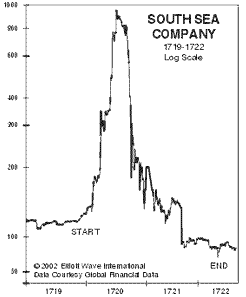
With the South Sea Bubble of 1720, there was a very fast evaporation of assets. Stockbrokers were looking for that second job.
With the current real estate bubble things should be somewhat different. There is an asset with a rental value. Rental values are pretty constant. At some point, the distressed property owner is going to realize that renting might be cheaper than paying on his present mortgage. The real owner of the property, shares ownership with the note holder. If the owner walks, the note holder is left holding the bag. Notice nothing has really happened, just a change of who is responsible for the asset. At this point the note holder has picked up a very healthy negative interest rate on his investment. No interest payments, property tax accrual, building maintenance and management.
Lets take a $600,000 house. It will take 9 months to foreclose unless they hand you the keys. Figure $27,000 in missed interest payments, $4,000 in property taxes. Now figure that the neighbor sells his for $550,000. Even though prices only dropped $50,000, the note holder has taken a $81,000 bath. In reality, they gave someone an interest free loan for 9 months and then paid their property taxes to boot. If there is Mello Roos, joke gets even worse!
The first thing to go "poof," is the second trust deed. The first trust deed still has some cushion albeit not much.
Second trust deeds would be a hot potato. There would be the urge to sell them. Say you have a $200,000 trust deed at 10% interest and you want to unload it fast. Discount the note so it pays 20% interest and sell it for $100,000 cash. Notice that you salvage 50% of a almost certain loss. What happened to the interest rate on the second trust deed market? it jumped to 20%! At this point, there is still no shortage of money yet, just a shortage of suckers looking for a steal. Raise the discount, you get more "investors." The aspect of risk is returning to the market.
What needs to be realized, is that this is a balancing act. Things can still be in harmony with everything so obviously out of whack. Nothing has really happened to make people want to "Throw in the towel." Something will trigger the fall, something very unexpected; a huge earthquake, a big bankruptcy , something we never dreamed possible.
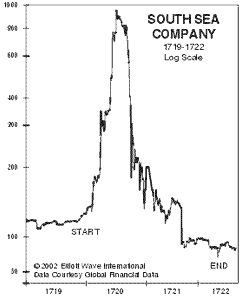
With the South Sea Bubble of 1720, there was a very fast evaporation of assets. Stockbrokers were looking for that second job.
With the current real estate bubble things should be somewhat different. There is an asset with a rental value. Rental values are pretty constant. At some point, the distressed property owner is going to realize that renting might be cheaper than paying on his present mortgage. The real owner of the property, shares ownership with the note holder. If the owner walks, the note holder is left holding the bag. Notice nothing has really happened, just a change of who is responsible for the asset. At this point the note holder has picked up a very healthy negative interest rate on his investment. No interest payments, property tax accrual, building maintenance and management.
Lets take a $600,000 house. It will take 9 months to foreclose unless they hand you the keys. Figure $27,000 in missed interest payments, $4,000 in property taxes. Now figure that the neighbor sells his for $550,000. Even though prices only dropped $50,000, the note holder has taken a $81,000 bath. In reality, they gave someone an interest free loan for 9 months and then paid their property taxes to boot. If there is Mello Roos, joke gets even worse!
The first thing to go "poof," is the second trust deed. The first trust deed still has some cushion albeit not much.
Second trust deeds would be a hot potato. There would be the urge to sell them. Say you have a $200,000 trust deed at 10% interest and you want to unload it fast. Discount the note so it pays 20% interest and sell it for $100,000 cash. Notice that you salvage 50% of a almost certain loss. What happened to the interest rate on the second trust deed market? it jumped to 20%! At this point, there is still no shortage of money yet, just a shortage of suckers looking for a steal. Raise the discount, you get more "investors." The aspect of risk is returning to the market.
What needs to be realized, is that this is a balancing act. Things can still be in harmony with everything so obviously out of whack. Nothing has really happened to make people want to "Throw in the towel." Something will trigger the fall, something very unexpected; a huge earthquake, a big bankruptcy , something we never dreamed possible.
Wednesday, June 21, 2006
What Will Make the Housing Bubble Pop?
The answer to that question is LACK OF FINANCING. Reality, is a banker that already has enough bad loans. That is not even close to happening. Most of the 100% loans that are resetting have value. The bank can sell the property for more than the note.
Inventory in San Diego has risen above 20,000 units and sales are at 4,000 for the month. Instead of calling this "5 months of inventory," lets call it what it is; a buyer seller ratio. There is one buyer for every 5 properties listed. Calling it "inventory" suggests that it would sell if only they had more time. More likely, its too high priced and would not sell, thats why the inventory numbers are increasing. The increasing numbers indicate the "block head mentality" of "what it use to be worth."
Another good indicator of a collapse would be an abundace of VA Repo's for sale. There are none right now, there were 3 last month for the whole state of California,--real dogs at outragious prices.
San Diego just passed the 1995 inventory high for housing that was set during the last BOTTOM in the real estate market. If you consider that a "train wreck," we are not even close to hitting anything yet. Phoenix has almost 50,000 listing and they are still selling real estate. In our area here, there are now about 5 cars in front of every house. It didn't use to be that way.
Noticeably, the papers are picking up on this phenomenon of excess housing. It is an item that is not really understood. Prices are stable and inventory is going up. What they need to realize, is that rich people can always afford to buy, it us poor people that can't afford these prices. So when nothing but high end houses sell, the average sale price increases or in this case stays about the same.
Right now, real estate is a one item event that cannot wreck on its own. Its going to need help. The capital financing this market is far from dead.
The other shoe has to drop, and I think that its name is Fannie Mae.
Inventory in San Diego has risen above 20,000 units and sales are at 4,000 for the month. Instead of calling this "5 months of inventory," lets call it what it is; a buyer seller ratio. There is one buyer for every 5 properties listed. Calling it "inventory" suggests that it would sell if only they had more time. More likely, its too high priced and would not sell, thats why the inventory numbers are increasing. The increasing numbers indicate the "block head mentality" of "what it use to be worth."
Another good indicator of a collapse would be an abundace of VA Repo's for sale. There are none right now, there were 3 last month for the whole state of California,--real dogs at outragious prices.
San Diego just passed the 1995 inventory high for housing that was set during the last BOTTOM in the real estate market. If you consider that a "train wreck," we are not even close to hitting anything yet. Phoenix has almost 50,000 listing and they are still selling real estate. In our area here, there are now about 5 cars in front of every house. It didn't use to be that way.
Noticeably, the papers are picking up on this phenomenon of excess housing. It is an item that is not really understood. Prices are stable and inventory is going up. What they need to realize, is that rich people can always afford to buy, it us poor people that can't afford these prices. So when nothing but high end houses sell, the average sale price increases or in this case stays about the same.
Right now, real estate is a one item event that cannot wreck on its own. Its going to need help. The capital financing this market is far from dead.
The other shoe has to drop, and I think that its name is Fannie Mae.
Tuesday, June 20, 2006
The Forever Impending Housing Collapse
A lot of the Bubble blogs are repeating the fact that we are about to have a housing collapse. I kind of think that this is rather like a Tsunami about to come in and the waters recede. At this point someone points out that there is going to be a seawater shortage.
The problem that is perceived is an over abundance of housing for SALE, NOT an over abundance of housing. There is a fine line here, but it is worthy to notice it. Somebody owns every one of these units. What we are looking at is an asset that has become less fungible (convertible to cash). It's less convertible because its price suddenly has no reliable point of reference. Ergo housing collapse.
I suggest a different venue. Its going to be the banks and loan companies that finance these loans that will hit the dust first. This will be reflected by a massive shrinkage of the money supply. All of this debt has to disappear, through BK or whatever. Once this happens, reality will hit the Real Estate Market.
The irritating thing about all of this, is that the Real Estate Bubble People think that this will be a single item event. There are going to be some bankruptcy's and most probably a trashing of the bond market. After that, when you find your IRA has been marked to market at an 80% loss, real estate, just might drop in price. Your dreams are dashed and you cannot afford to retire at age 65.
Sound ridiculous,doesn't it? It happened in 1929, history doesn't repeat itself, believe that and I have another for you.
The problem that is perceived is an over abundance of housing for SALE, NOT an over abundance of housing. There is a fine line here, but it is worthy to notice it. Somebody owns every one of these units. What we are looking at is an asset that has become less fungible (convertible to cash). It's less convertible because its price suddenly has no reliable point of reference. Ergo housing collapse.
I suggest a different venue. Its going to be the banks and loan companies that finance these loans that will hit the dust first. This will be reflected by a massive shrinkage of the money supply. All of this debt has to disappear, through BK or whatever. Once this happens, reality will hit the Real Estate Market.
The irritating thing about all of this, is that the Real Estate Bubble People think that this will be a single item event. There are going to be some bankruptcy's and most probably a trashing of the bond market. After that, when you find your IRA has been marked to market at an 80% loss, real estate, just might drop in price. Your dreams are dashed and you cannot afford to retire at age 65.
Sound ridiculous,doesn't it? It happened in 1929, history doesn't repeat itself, believe that and I have another for you.
Subscribe to:
Posts (Atom)