Friday, August 24, 2007

DJIA Stock Market Math

The DJIA just went up 143 points or did it? Here is an abbreviated re edit of a previous post The Stock Market Game from April 25th. The market at that time was at 13,000 and I am going to use the figures for that date. If you held one share of each stock in the Dow Jones average, you would have had an increase in equity of less than 18 dollars with today’s surge.

The "Dow Jones Industrial Average" sounds impressive. Right now it’s at 13,000. Add up the value of all thirty stocks in the DOW and you get 1,600. Hmmm where does the 13,000 come from?

There is the Dow divisor index which is currently at 0.1248. This is a peculiar animal.

Here is a cut and paste from Wikipedia:

Assume an index comprising on 2 stocks A and B.
A is priced at $100 and B is priced at $200.
Hence the index value in this case is (100+200)/2=150
(where N=2 which is index divisor). So the index value here is 150.

Now assume stock B undergoes 2:1 stock split so its value becomes $100.
Now the index value would become 100 instead of 150.
To correct his irregularity we need to do the index divisor calculation as
(100+100)/N=150 (Since Market Capitalization of the stock is unchanged).
Hence, upon calculation we get the value of N as 1.333.
This shows that a stock split caused the index divisor to be revised
from a value of 2 to 1.33.


Today with the DOW, you would take 1600/.1248=12,820

DOW 30 Stocks---------------Weight %-----Present Value
3M Co.--------------------------4.8746---------77.75
Alcoa Inc-----------------------2.15-------------34.37
Altria Group-------------------4.3605---------69.55
American Express------------3.8245---------61
American International ----4.3593---------69.53
AT&T Inc--------------------- 2.4997---------39.87
Boeing Co. --------------------5.8489---------93.29
Caterpillar Inc. --------------4.5028---------71.82
Citigroup Inc. ----------------3.3492---------53.42
Coca-Cola Co. ----------------3.2659---------52.09
DuPont------------------------ 3.0897---------49.28
Exxon Mobil Corp. ----------5.0007---------79.76
General Electric Co.---------2.2025---------35.13
General Motors Corp.-------1.9862---------31.68
Hewlett-Packard Co.--------2.5937----------41.37
Home Depot Inc.------------2.4583---------39.21
Honeywell-------------------- 3.2226---------51.4
Intel Corp.--------------------1.3894----------22.16
IBM----------------------------5.9298---------94.58
Johnson & Johnson---------4.0828---------65.12
JPMorgan Chase & Co.-----3.2941---------52.54
McDonald's Corp.-----------3.032-----------48.36
Merck & Co. Inc.-------------3.2282---------51.49
Microsoft Corp.--------------1.8194----------29.02
Pfizer Inc.---------------------1.6909---------26.97
Procter & Gamble-----------4-----------------63.8
United Technologies-------4.2307----------67.48
Verizon-----------------------2.3768----------37.91
Wal-Mart Stores Inc.------3.1198---------49.76
Walt Disney Co.------------2.2119---------35.28
Total-------------------------99.9998------1594.99


If you examine the Market Weighted %, this is the actual amount the Dow swings per dollar for each individual stock. Notice that a 5 dollar move in IBM translates into 30 points on the DOW (5 x 5.92). A 5 dollar move in Intel translates into 7 points on the DOW (5 x 1.38).


As boring as all of this is, its rather like doing 20 miles per hour in a car and the Manufacturer decides to add another zero to the speedometer and make it 200. In that scenario, you can go through a hospital zone at 200 mph and not suck the drapes out of the rooms.

DOW 13,000 sounds super, but when you add it up you begin to realize that the perspective is a little misleading. The DJIA 30 stocks are worth $1600. The real validity of the DOW hitting 13,000 has more to do with someone who bought into the market in about the year 1910.

So an $800 dollar drop in value of the 30 Dow stocks drops the Dow down six or seven thousand points.

The $1,600 hundred dollar value for the Dow is a concept I understand. When you start fiddling with graphs and divisors, things take on a look that can be quite misleading. Terms like P/E, Earnings, Book Value, Dividend mean nothing, afterall "It’s a high powered growth stock." It’s kind of like asking you daughter about her new boyfriend and what he does for a living and she says “It doesn’t matter Dad, he’s a STUD.” That's a good indication that Rug Rat “Welfare One” is probably on the way.

Saturday, August 18, 2007

The Wyle E. Coyote Acme Credit Loan

The Fed's over night discount rate cut of Friday has a lot of people wondering; "What is going on?" and "Why it was done?" I could be shot again for over simplification on this one. On the plus side, there are no complicated graphs, so read on.

Imagine a bunch of little stores that are about to open in the morning. Before they open, they go to the cash register and put in their transaction money for the day. This would be something like 5 20’s, 10 10’s, 20 5’s and 40 1’s and quarters, dimes nickels and pennies. This money is needed to open the store. The bigger the store, the more transaction money is needed.

Now let’s go one step further. Suppose the money is not there to open the store. Most businesses have an open credit line with their bank for such occasions. They can go down and borrow the money. What the heck, at the close of business, they can pay it back.

On to step three, the banks issue these lines of credit to businesses thinking that maybe only five to ten percent of their clients will call for such a loan at any one time. They were not counting on all of their clients lining up at the credit line window at the same time. The bank at this point has over contracted these lines of credit, and has to go to the Fed window for an overnight loan. Wasn’t it Countrywide that exercised their line of credit for 11.5 billion Thursday with 41 lenders?

So what is happening? New money is not flowing into the system. People are not borrowing, buying or what ever. The money supply is contracting. Lowering the discount rate, allows banks to make those loans to business so they can open with cash in the drawer ready for business. It’s no longer an over-nighter, hey pay us when you can. I think the Fed is stealing the same boiler plate previously used on home loans.

But why did the stock market go up? The increased access to liquidity allows the big traders to exercise their credit lines. After all buying and selling stocks is a business. You’ll notice that Bernanke picked an expiration Friday, (before the market opened) to drop the discount rate, which burned the short option players royally. Done like a true professional!

Halloween is early this year, the third Friday (Thursday if you're smart) in September, a Triple Witching Expiration. I guess I’ll mosey over for some cider and donuts at the 11.5 billion dollar bon(d)fire.

Thursday, August 16, 2007

Possible Explosion on Wall Street???

Then:

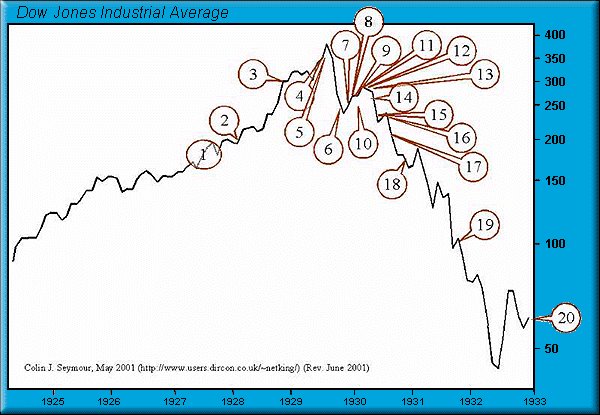
The Dow Jones hit a high of 381 September 3, 1929. By Wednesday October 23 it had dropped to 305. On Black Thursday October 24th 1929, the stock market was in a free fall. The market had fallen to 274. Then at 1:30 Richard Whitney Vice President of the Stock exchange walked to trading post number two, US Steel and announced a bid of 205 for 10,000 Steel. This was 40 points above the market price. He then went on to several other posts and placed bids for stock above the market price. The stock market came back to close at 299 (The money for his bids was fronted by JP Morgan et al). The following Monday the market dropped to 260 and then on Black Tuesday the market dropped to 230.

And Now:

The Dow Jones hit a high of 14,000 July 19, 2007. By Wednesday August 16, 2007 it had dropped to 12,861. On Thursday the market started dropping down about 350 points and came back to close at 12,845.

It looks like Bernanke is the replacement for the historical JP Morgan banker’s consortium of 1929. It kind of makes you wonder if the rest of what is about to happen, hasn’t already been written. It's probably just my imagination running amok again.

BTW can somebody go over to Bear Sterns and turn out the lights? I guess we won’t read the obit until they pull the plug. Plus, I hear that Country Wide is in an adjoining bed.

Tuesday, August 14, 2007

Famous Quotes From the Past revisited

This is a reprint of my 9/03/06 post it seems appropriate for today, you might have missed it.

Here is something that I ran across that seems like a parallel to todays mindset.

This is a link to the site: http://www.gold-eagle.com/editorials_01/seymour062001.html


1927-1933 Chart of Pompous Prognosticators


1. "We will not have any more crashes in our time."
- John Maynard Keynes in 1927

2. "I cannot help but raise a dissenting voice to statements that we are living in a fool's paradise, and that prosperity in this country must necessarily diminish and recede in the near future."
- E. H. H. Simmons, President, New York Stock Exchange, January 12, 1928

"There will be no interruption of our permanent prosperity."
- Myron E. Forbes, President, Pierce Arrow Motor Car Co., January 12, 1928


3. "No Congress of the United States ever assembled, on surveying the state of the Union, has met with a more pleasing prospect than that which appears at the present time. In the domestic field there is tranquility and contentment...and the highest record of years of prosperity. In the foreign field there is peace, the goodwill which comes from mutual understanding."
- Calvin Coolidge December 4, 1928

4. "There may be a recession in stock prices, but not anything in the nature of a crash."
- Irving Fisher, leading U.S. economist , New York Times, Sept. 5, 1929

5. "Stock prices have reached what looks like a permanently high plateau. I do not feel there will be soon if ever a 50 or 60 point break from present levels, such as (bears) have predicted. I expect to see the stock market a good deal higher within a few months."
- Irving Fisher, Ph.D. in economics, Oct. 17, 1929

"This crash is not going to have much effect on business."
- Arthur Reynolds, Chairman of Continental Illinois Bank of Chicago, October 24, 1929

"There will be no repetition of the break of yesterday... I have no fear of another comparable decline."
- Arthur W. Loasby (President of the Equitable Trust Company), quoted in NYT, Friday, October 25, 1929

"We feel that fundamentally Wall Street is sound, and that for people who can afford to pay for them outright, good stocks are cheap at these prices."
- Goodbody and Company market-letter quoted in The New York Times, Friday, October 25, 1929


6. "This is the time to buy stocks. This is the time to recall the words of the late J. P. Morgan... that any man who is bearish on America will go broke. Within a few days there is likely to be a bear panic rather than a bull panic. Many of the low prices as a result of this hysterical selling are not likely to be reached again in many years."
- R. W. McNeel, market analyst, as quoted in the New York Herald Tribune, October 30, 1929

"Buying of sound, seasoned issues now will not be regretted"
- E. A. Pearce market letter quoted in the New York Herald Tribune, October 30, 1929

"Some pretty intelligent people are now buying stocks... Unless we are to have a panic -- which no one seriously believes, stocks have hit bottom."
- R. W. McNeal, financial analyst in October 1929


7. "The decline is in paper values, not in tangible goods and services...America is now in the eighth year of prosperity as commercially defined. The former great periods of prosperity in America averaged eleven years. On this basis we now have three more years to go before the tailspin."
- Stuart Chase (American economist and author), NY Herald Tribune, November 1, 1929
"Hysteria has now disappeared from Wall Street."
- The Times of London, November 2, 1929

"The Wall Street crash doesn't mean that there will be any general or serious business depression... For six years American business has been diverting a substantial part of its attention, its energies and its resources on the speculative game... Now that irrelevant, alien and hazardous adventure is over. Business has come home again, back to its job, providentially unscathed, sound in wind and limb, financially stronger than ever before."
- Business Week, November 2, 1929

"...despite its severity, we believe that the slump in stock prices will prove an intermediate movement and not the precursor of a business depression such as would entail prolonged further liquidation..."
- Harvard Economic Society (HES), November 2, 1929


8. "... a serious depression seems improbable; [we expect] recovery of business next spring, with further improvement in the fall."
- HES, November 10, 1929

"The end of the decline of the Stock Market will probably not be long, only a few more days at most."
- Irving Fisher, Professor of Economics at Yale University, November 14, 1929

"In most of the cities and towns of this country, this Wall Street panic will have no effect."
- Paul Block (President of the Block newspaper chain), editorial, November 15, 1929

"Financial storm definitely passed."
- Bernard Baruch, cablegram to Winston Churchill, November 15, 1929


9. "I see nothing in the present situation that is either menacing or warrants pessimism... I have every confidence that there will be a revival of activity in the spring, and that during this coming year the country will make steady progress."
- Andrew W. Mellon, U.S. Secretary of the Treasury December 31, 1929
"I am convinced that through these measures we have reestablished confidence."
- Herbert Hoover, December 1929

"[1930 will be] a splendid employment year."
- U.S. Dept. of Labor, New Year's Forecast, December 1929


10. "For the immediate future, at least, the outlook (stocks) is bright."
- Irving Fisher, Ph.D. in Economics, in early 1930

11. "...there are indications that the severest phase of the recession is over..."
- Harvard Economic Society (HES) Jan 18, 1930

12. "There is nothing in the situation to be disturbed about."
- Secretary of the Treasury Andrew Mellon, Feb 1930

13. "The spring of 1930 marks the end of a period of grave concern...American business is steadily coming back to a normal level of prosperity."
- Julius Barnes, head of Hoover's National Business Survey Conference, Mar 16, 1930
"... the outlook continues favorable..."
- HES Mar 29, 1930


14 "... the outlook is favorable..."
- HES Apr 19, 1930

15. "While the crash only took place six months ago, I am convinced we have now passed through the worst -- and with continued unity of effort we shall rapidly recover. There has been no significant bank or industrial failure. That danger, too, is safely behind us."
- Herbert Hoover, President of the United States, May 1, 1930
"...by May or June the spring recovery forecast in our letters of last December and November should clearly be apparent..."
- HES May 17, 1930

"Gentleman, you have come sixty days too late. The depression is over."
- Herbert Hoover, responding to a delegation requesting a public works program to help speed the recovery, June 1930


16. "... irregular and conflicting movements of business should soon give way to a sustained recovery..."
- HES June 28, 1930

17. "... the present depression has about spent its force..."
- HES, Aug 30, 1930

18. "We are now near the end of the declining phase of the depression."
- HES Nov 15, 1930

19. "Stabilization at [present] levels is clearly possible."
- HES Oct 31, 1931

20. "All safe deposit boxes in banks or financial institutions have been sealed... and may only be opened in the presence of an agent of the I.R.S."
- President F.D. Roosevelt, 1933


Quotes #5 and #8 are very famous remarks by Irving Fisher, who at the time was managing the Yale endowment funds. It didn't go well from there.

These were very intelligent people back in their time. Their thoughts on what would happen next were way off the mark. What was said, sounded good and was reassuring.

It leaves a lot of doubt about what you can take for granted in todays newspapers

Note, quote 20 refers to the fact that it became illegal to own gold as an American citizen. The government was making sure no one was holding out on them. You had to trade your gold in for currency. This was FDR's way of keeping everyone honest--government excluded.

Wednesday, August 08, 2007

Surfing The Kondratieff Wave

Here is An Article I wrote 5/8/06, I thought it worth repeating.

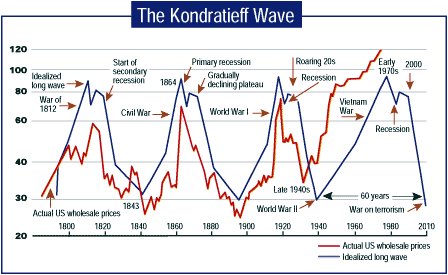
If you're into investment cycles and charts, the Kondratieff Wave is one to examine. Basically the boom and bust cycle had a 60 year span. Here is a link to more detail http://www.kwaves.com/kond_overview.htm Credit the picture above from this link.

The cycle this time around is a little long in the tooth. There is a reason for this and I believe as do some others, that it has to do with the increase in the length of the average persons life span.It use to be about 60 years now we are up to about 75 years.

Each generation has a group of elders that can draw from past mistakes. We are at a point right now, that the follies of the 1920's and 1930's are not part of our "group memory" any more. Most people from that era would be at least 100 years old now. Now when you quote some historical aspect a cause of the last depression, you hear the phrase,"Its different this time."

People today think that the interest only no money down mortgage is something new. Well it isn't. They were written right up to the collapse in 1929. The banks soon realized that it was like the neighbor taking out your daughter for a "test drive" before he married her. The responsibility factor was missing.

Cycles are usually displayed as circles that would follow through phases and complete back where they started. I think that this is not a true analogy of what is happening here. If you start with a spiral going out from the center, this more correctly displays "history repeating itself." It s not quite the same, things have changed somewhat.

People are consuming more and more, and with that, comes the creation of more debt. It is this debt that will be marked to market. Mr. Kondratieff's theory suggests that all of this debt will disappear and the money supply will contract accordingly (drastically in this case).

I don't think that people fully realize how money disappears. Take Lucent Technologies a few years back. It sold for $80 per share and went down to $2. Somebody owned it the whole way down.

What really scares me today, is the people with savings and retirement funds, they have been funding this whole thing. The market will always go up (believe that and I'll tell you another). The trouble is, a majority of the owners of wealth, are going to want to get out of the market pretty soon and they are at the head of the line-- the baby boomer's.The baby boomer's think that this will be a relaxing walk into retirement. More likely its going to be one hell of a panic. If Mr Kondratieff is right, there will be a drastic contraction of the money supply because of the debt marked to market, and because of this, commodities should fall in price.

My question is this. If the world population has increased 4 times in the last 60 years and most of these governments have been printing money at a very vigorous rate, can gold and silver still be considered commodities? I think that they reside outside the realm of consumables.

Saturday, August 04, 2007

The Jim Cramer Implosion

I watched the Jim Cramer of Mad Money melt down on CNBC Friday. Here is a Link to it. He wants Bernenke to lower the interest rates. It was kind of a toss up as to whether it was an act or not. You wouldn’t normally pull stuff like that with people you work with on a daily basis. I don’t think that Erin Burnett who was interviewing him was enjoying the loss of control. I am sure that she thought he deserved a kick in the nuts.

Today on Bloomberg Jim Rogers was interviewed and he referred to the auto industry, the housing industry and the finance industry as being in a recession. He had to correct himself when he tried to pronounce “recession” with a “d,” on two occasions. Just maybe it’s time to pass out the life jackets.

Jim Cramer seems to think that lowering the discount rate is going to save the market. In his way of thinking it will save the market. It will save the quid pro quo. I think we are tired of the salesmanship of, “If this erection lasts more than 4 hours. . . .” In reality we have a stock market that is out of control, we need a meltdown to restore reality. Google alone is pumped up on steroids.

On a good note, we have Wells Fargo raising the Jumbo rate to 8%. This for once seems like a realistic rate for long term home loans. It’s not that I wouldn’t like them lower; it’s the spread between short term and long term that has now gotten healthy. There is now a premium for investing long term that wasn’t present in the past. Things are starting to make sense now.

Bear Sterns is still in control of seating arrangements on the Titanic—I think they are going to move the band to the back of the boat, everyone loves music. It will surprise the people coming back from the life boat tour of the iceberg.

Doomed October Real Estate Figures

June 21, Bear Sterns hit a brick wall. In the last 6 weeks, the real estate finance markets have tightened up. No more easy loans. Home owners are looking at June Housing figures which are 30 days behind today’s date and the purchase date is 30 to 90 days behind that. These homes went into escrow 8 to 16 weeks ago and have been in the sold category for less than 4 weeks.

Notice one thing, the effect of the new lending standards has not even shown up in the real estate statistics. Even if we did a 30 day escrow, the June 21 contract signing would not show up in statistics until September 1. So in effect real numbers for the new lending criteria will not show their effect until October 1, or later (30 to 90 days from now).

If we examine this more minutely, you find that the home owner trying to sell is three months behind the curve. The newspaper figures for home values are a tad bit stale. The number of house sellers has increased, and the people that qualify as buyers have decreased considerably.

The October housing statistics should start to reflect the new lending standards. I would expect to see a very substantial drop in home purchases in San Diego. A lot of people won’t be able to qualify for a home loan. They don’t earn enough to afford the monthly payments; of course that fact didn’t seem to bother anyone a month ago.

Now as of last night, Wells Fargo has announced that its Jumbo rate has now jumped to 8%. So now you can buy a McMansion and they will super size your interest rate (what a deal!). This is a take out order; the current seller gets his lunch and a free ride to the poor house without lifting a finger. Notice that the words “free” and “lunch” were not next to each other.

Friday, August 03, 2007

It Friday

I'm still working on a couple of things. Nothing ready to publish. Dr Housing Bubble has a nice piece to read today you might want to give it a click
Link

It's a letter from a lawyer from the 1930's dealing with farm foreclosures.

Monday, July 30, 2007

Housing Death Knell for the Economy

Between January, 2005 and today, 16 million houses have been sold. Let's figure that the new owner probably paid double of what is was worth. So a 100k to 300k house was purchased for 200k to 600k. Figure that the new market price averages out to 300k.

Multiply 16 million homes by 300k and you end up with 4.8 trillion dollars worth of homes that have mortgages with less than desirable collateral. The owner paid too much and is struggling to hang on. So 50% of that total is about 2.4 trillion dollars. This was money added to the economy that no one had to work for, AKA bubble money.

In the past, the yearly appreciation of the home meant that the money extracted never had to be repaid. Now, the house has ceased to appreciate in value. To the over extended home owner, this change of the rules is just not logical. Everyone knows that housing always appreciates.

The US census lists the total number of housing units in the United States as 125 million as of 2005. How much equity was pulled out of all of the remaining units (125-16=109 million)? You really don’t know where to even start. We could double what was calculated for the 16 million homes purchased and call that an estimate of what the housing owners extracted from their new found equity. That would put the amount of bubble money introduced into the economy at 5 trillion dollars. This money flowing into the economy has stopped. Coincidently, the total United States budget for the last 2 & ½ years was also 5 trillion dollars.

When you realize that the last time we had something this bad in the housing market, it took 5 years to get where we are at now, and we’ve done this all in one year. Talk about over achievers, we’ve outdone ourselves!

The economy is what will be hit and hit hard. It may take time, but what is about to happen, is now more than obvious.

On the lighter side, here is some good news; Congress is going to pass a law to double the number of feet in a mile from 5,280 to 10,560. This will cut our distance to work by half thus decreasing gas consumption by 50%, God bless them!

Sunday, July 29, 2007

The Impeding Hangover

I’ve watched the stock market since about 1958. I was about 12 at the time and my grandfather would take me down to the brokerage office and we would watch the stock ticker print out a never ending trail of letters and numbers. One tape printed on a transparent ticker tape which was projected onto a screen and the other was on a regular ticker tape. Now and then one of the workers would tear off about 3 feet of the regular tape and go up to a 10 X 40 foot chalk board and update the quotes. There was seating for about 50 people, and most were as old as my grandfather. The thing I liked was that the workers would give me the short rolls of unused tape to play with. That was my entertainment from 1 to 4 PM.

Later on in the 60’s and 70’s I watched my father and his stock investments. He even formed an investment club that a lot of the neighbors joined. As an investment group they could afford to buy 100 shares of a stock. Remember wages were about $8,000 per year. The investment group deteriorated over time, people just didn’t have the money or they moved away. It was not the road to riches, it was boring.

A bear market started in 1974 that did some damage, but it didn’t really affect the general population (the DJIA went to 607). It affected the rich and the well to do, their net worth dropped considerably.

I got into the market about 1982. The DJIA was about 1100. My broker had a sign on his desk saying “DOW 2000.” It was always good for a chuckle; everyone was hoping that it would happen, we just didn’t know when.

The people making money were the stock brokers. A typical buy or sell transaction on 100 shares was about a $300 dollar commission. A round trip on one stock would cost you $600. It had to go up at least 6 points to break even. There was an additional $35 dollar charge for an odd lot sale of less than 100 shares

In 1985 I started using a discount broker. Round trip on 100 shares dropped to $220 which wasn’t too bad. Plus, everything was going up. Then, the real discount brokers came online with the advent of internet trading. From there, everyone piled into the market. 20 years ago dropping a stock name at a party would have gotten you a blank stare. Today, everyone talks stocks.

There has been no time since 1929 that we have had this percentage of people in the market that know utterly nothing about what they are doing. The Jim Cramer Stock Show has got to be an indicator of a market top (we are all going to get rich). They’re having fun, no need to spoil the party. Have another drink.

The bears are restless, this could be the week.

FYI, the DJIA circuit breaker that would close the market for the rest of the day is now 4,050 points. It’s nice to know that any future stock market panic has been well thought out. So if you feel like jumping, pick a ledge and grab a number.