Happy New Year everyone!
I started this blog in May of 2006 and from my perspective, it should take two years before most people will realize that we are in a major depression. Well, we are almost half way there. It's kind of like a rear view mirror perspective, we'll see it only after it's behind us.
Real estate is not doing very well. I saw a new word the other day that was referring to the current status of property for sale "fugly." Two four letter words combined to express a diagnosis that is a bit on the strong side.
A lot of the issues point to problems further ahead, foreclosure's, refinancing and bankruptcy. These are all real estate related.
The organization that I work for has installed over 2 million dollars worth of computer equipment last year, and all of it says "Made in China." Is there anyone in the United States producing anything besides food that is making a profit?
Then you hear the speculation of the DJIA going to 20,000. I think that we have a market where speculation is King and Reason has no Consort. Very few companies even pay a dividend that would support their current price on the DJIA. Retirement time is close for the baby boomer's and if it doesn't pay a dividend, why hold it? Questions abound unanswered. Why worry the market is going up, Right! "Up what?" is question to ask! Your IRA could have a sick call like back in 2001. The 50% haircut wasn't about hair salons.
Wednesday, January 03, 2007


Thursday, December 21, 2006
Banker's Nightmare
I have been watching foreclosure.com for about 4 months and have been keeping track of the data for California.
Just for a lark, I decided to plot the data on semi-logarithmic graph paper. My thinking process revolved around the idea of what a banker would do to forecast for the future mortgage delinquency's and this looked like a pretty good start. If you're a banker, this has to be a graph that is hopefully flawed! If not, there is going to be some pain.
This graph plots the increasing foreclosures in the California market and the predicted future foreclosures. Three lines are drawn High, Middle and Low estimates based on data supplied. Double click on the graph for an enlarged view.
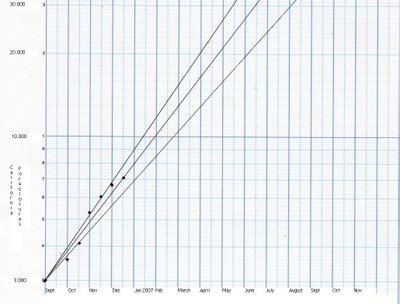
A few interesting notes. The total foreclosures for 7/29 was 3,384 (a data point I didn't use) and the figure for 9/1 was 3,060. 324 foreclosures disappeared. What we could be looking at here, are Notices of Default (NOD) being filed and as in say a bankruptcy, the bank accepts the deed in lieu of foreclosure. Bankruptcies do not necessarily generate a NOD but the banks acceptance of the property would probably cure the NOD.
What we cannot see in real time that the banker can, is how many people he has on their way to a NOD that he is aware of. We don't see the figures until the NOD is filed. If it's a bankruptcy, there just might not be a NOD.
So, back to the visual aid here, if you look at the middle of next June, we could be looking at about 23,000 foreclosures. This years total will probably be less than 8,000, but if we "trust" the graph, we are going to be in pain in June of next year.
The real issue here is, if the data assumptions are correct for June of 2007, this implies a banking crisis far greater than the Savings & Loan debacle of the 1990's.
Just for a lark, I decided to plot the data on semi-logarithmic graph paper. My thinking process revolved around the idea of what a banker would do to forecast for the future mortgage delinquency's and this looked like a pretty good start. If you're a banker, this has to be a graph that is hopefully flawed! If not, there is going to be some pain.
This graph plots the increasing foreclosures in the California market and the predicted future foreclosures. Three lines are drawn High, Middle and Low estimates based on data supplied. Double click on the graph for an enlarged view.
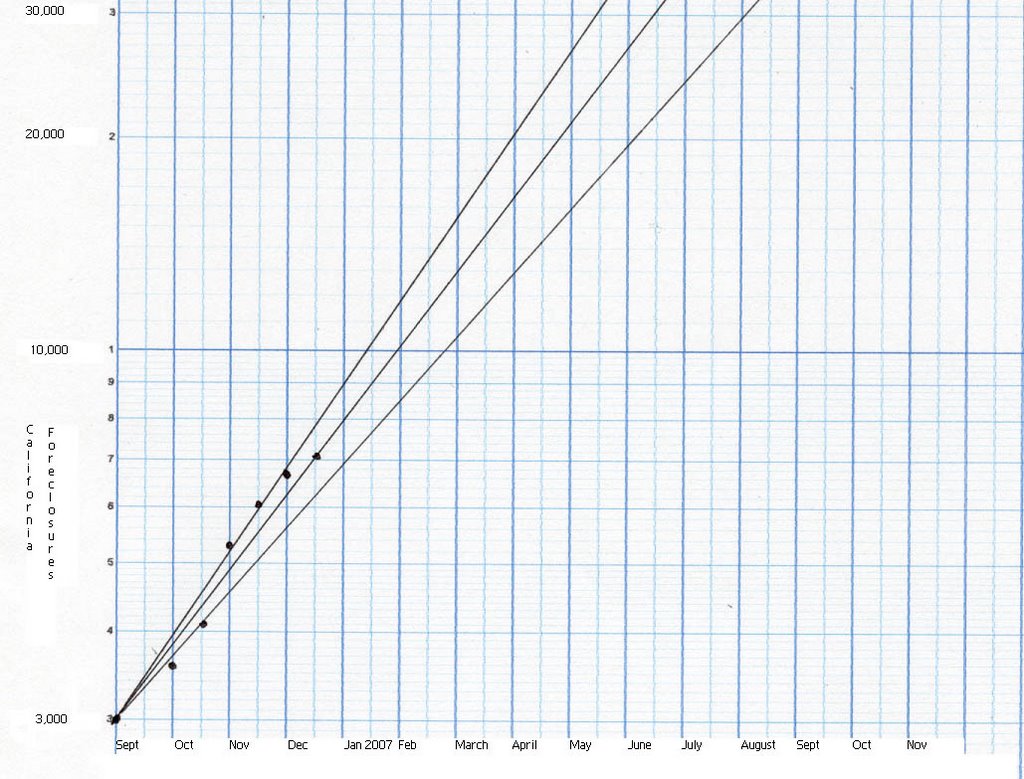
A few interesting notes. The total foreclosures for 7/29 was 3,384 (a data point I didn't use) and the figure for 9/1 was 3,060. 324 foreclosures disappeared. What we could be looking at here, are Notices of Default (NOD) being filed and as in say a bankruptcy, the bank accepts the deed in lieu of foreclosure. Bankruptcies do not necessarily generate a NOD but the banks acceptance of the property would probably cure the NOD.
What we cannot see in real time that the banker can, is how many people he has on their way to a NOD that he is aware of. We don't see the figures until the NOD is filed. If it's a bankruptcy, there just might not be a NOD.
So, back to the visual aid here, if you look at the middle of next June, we could be looking at about 23,000 foreclosures. This years total will probably be less than 8,000, but if we "trust" the graph, we are going to be in pain in June of next year.
The real issue here is, if the data assumptions are correct for June of 2007, this implies a banking crisis far greater than the Savings & Loan debacle of the 1990's.
Monday, December 18, 2006
Real Estate Musings
Everybody is familiar with the standard bell curve. That's what this little curve is all about. This is nothing scientific but rather a walk through some constructive thinking. This time, we choose to pick on real estate.
The values don't have to be quite right, its the concept that we are after. Notice that 50% of the real estate is classified as less than nice (ie Crappy to OK).
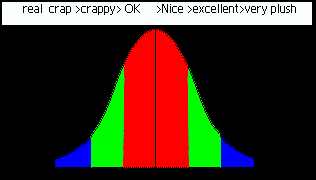
As a buyer, your interest will lie with the 50% to the right (nice to plush). In just generalizing, half of the market is really non existent. We could define "Real Crap"; as too old and run down, or gang neighborhood or an absurd asking price for say a 700 foot starter home. Nice could be defined as; "better than anything we have been shown before by this realtor," or brand new. Excellent could be defined as something we would like but cannot afford.
Just from reading the other blogs and comments, it looks as if its the "Nice" and the "Excellent homes are selling. My interpretation of this is that these people who are selling, are reducing their prices to accommodate the perspective buyer. Home builders top the list, and anybody that was lucky enough to buy before the tremendous price rise I would also include in this group.
Notice how sales in the right side of the bell curve would skew the "Median Home Sale Price," even higher when the seller is reducing his expected price (ie the sellers house was valued at 700k but they were willing to accept 600k) If the median price was 500k, you see that increase in a declining market.
So what are we looking at? 50% of the sellers on this bell curve have bought high and are stuck, you can't sell low. Considering the numbers, this is an awful lot of stressed real estate!
The banks or financial institutions that are holding the paper can see what has to transpire next, and it looks as if, "Maybe if we give it some more time, "Real estate could come back and save our ass!"
Loan writers are still cranking out the loans, fewer of them, but the game is still being played. Just where is the money coming from? Maybe from some GSE (government sponsored enterprise)--I wonder who could be buying the notes?
The values don't have to be quite right, its the concept that we are after. Notice that 50% of the real estate is classified as less than nice (ie Crappy to OK).
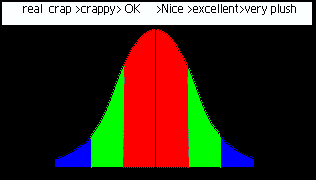
As a buyer, your interest will lie with the 50% to the right (nice to plush). In just generalizing, half of the market is really non existent. We could define "Real Crap"; as too old and run down, or gang neighborhood or an absurd asking price for say a 700 foot starter home. Nice could be defined as; "better than anything we have been shown before by this realtor," or brand new. Excellent could be defined as something we would like but cannot afford.
Just from reading the other blogs and comments, it looks as if its the "Nice" and the "Excellent homes are selling. My interpretation of this is that these people who are selling, are reducing their prices to accommodate the perspective buyer. Home builders top the list, and anybody that was lucky enough to buy before the tremendous price rise I would also include in this group.
Notice how sales in the right side of the bell curve would skew the "Median Home Sale Price," even higher when the seller is reducing his expected price (ie the sellers house was valued at 700k but they were willing to accept 600k) If the median price was 500k, you see that increase in a declining market.
So what are we looking at? 50% of the sellers on this bell curve have bought high and are stuck, you can't sell low. Considering the numbers, this is an awful lot of stressed real estate!
The banks or financial institutions that are holding the paper can see what has to transpire next, and it looks as if, "Maybe if we give it some more time, "Real estate could come back and save our ass!"
Loan writers are still cranking out the loans, fewer of them, but the game is still being played. Just where is the money coming from? Maybe from some GSE (government sponsored enterprise)--I wonder who could be buying the notes?
Saturday, December 09, 2006
Stock Market Quirks
Back in 1987 crash there was a new phenomenon. Everyone that tried to call their discount broker couldn’t get through, the lines were busy. A lot of the new ownership of stock was held in Street Name, not in the buyer’s name. The difference here was that back in time, people took delivery of the stock certificate. The inconvenience of taking delivery meant that you might have to wait up to 4 weeks for receipt of the certificate. In today’s fast market that could be a drawback.
There was no problem walking into a full service broker that October day and handing them a certificate and telling them to sell it. If you were with a discount broker, you couldn’t get in the door, there was a line.
Let’s troll on to the present. A majority of people with a brokerage account today are online through the internet. Ask yourself one question. What would happen today if the market went south and everybody tried to logon and put in a sell order at the same time? I think we all get that question right. The difficult question would be; “What is the real trading price of your stock if everyone that wanted to sell could get on line and sell.” This is what happened in 1929, the market ticker was 6 hours behind actual trades. People were trading blind. The internet lockup might be a good thing, because in 1929 the market came back. So no action makes a lot of sense.
Enter the mutual fund manager with his computer program for trading the market. Let’s figure that between 1,000 and 8,000 mutual funds/Ira/etc decide to play. If you decide to not play, your fund gets valued by the other’s trading. It will be similar to your automatic sprinklers’ kicking on while you’re having an outdoor dinner party. Both events are planned, what happens isn’t.
In theory, 100 shares of IBM sold at market during a panic could have a real bid of 5 cents a share. That would net the seller 5 dollars. Don’t forget the 8 dollar discount brokerage fee. That sure beats the full service commission from a regular broker, doesn’t it!
There was no problem walking into a full service broker that October day and handing them a certificate and telling them to sell it. If you were with a discount broker, you couldn’t get in the door, there was a line.
Let’s troll on to the present. A majority of people with a brokerage account today are online through the internet. Ask yourself one question. What would happen today if the market went south and everybody tried to logon and put in a sell order at the same time? I think we all get that question right. The difficult question would be; “What is the real trading price of your stock if everyone that wanted to sell could get on line and sell.” This is what happened in 1929, the market ticker was 6 hours behind actual trades. People were trading blind. The internet lockup might be a good thing, because in 1929 the market came back. So no action makes a lot of sense.
Enter the mutual fund manager with his computer program for trading the market. Let’s figure that between 1,000 and 8,000 mutual funds/Ira/etc decide to play. If you decide to not play, your fund gets valued by the other’s trading. It will be similar to your automatic sprinklers’ kicking on while you’re having an outdoor dinner party. Both events are planned, what happens isn’t.
In theory, 100 shares of IBM sold at market during a panic could have a real bid of 5 cents a share. That would net the seller 5 dollars. Don’t forget the 8 dollar discount brokerage fee. That sure beats the full service commission from a regular broker, doesn’t it!
Friday, December 01, 2006
Bankruptcy Vs Forclosure
If you cruze any of the other sites I have as favorites, you'll observe that a lot of the chatter is about home foreclosure's.
Click on this site Forclosures. Notice the foreclosure statistics and also the bankruptcy stats.
This is where it gets interesting. A reader pointed out something to me that I hadn't known about(his email):
In a round about way, we are talking about bankruptcies and how lawyers handle them. It looks as if a bankruptcy lawyer goes to the bank and points out what is going to happen next (with regards to his client) and the Banker has only two options, take the deed in lieu of foreclosure or go the whole 10 yards the hard way. Notice that this circumvents the NOD (Notice of Default).
What we have here is a hell of a lot of bankruptcies, and it looks as if the NOD's will never be filed. The only conclusion you can draw from this, is that the banks are picking up a lot of real estate that is being missed by the bean counters.
Look at how much of what is happening, can be hidden from view. Neat Huh????
Click on this site Forclosures. Notice the foreclosure statistics and also the bankruptcy stats.
This is where it gets interesting. A reader pointed out something to me that I hadn't known about(his email):
One subject that is not getting covered in the press is the
inaccuracy of foreclosure statistics. This is because there are huge numbers of
"deeds in lieu of foreclosure" being taken in by lenders instead of foreclosures.
In a round about way, we are talking about bankruptcies and how lawyers handle them. It looks as if a bankruptcy lawyer goes to the bank and points out what is going to happen next (with regards to his client) and the Banker has only two options, take the deed in lieu of foreclosure or go the whole 10 yards the hard way. Notice that this circumvents the NOD (Notice of Default).
What we have here is a hell of a lot of bankruptcies, and it looks as if the NOD's will never be filed. The only conclusion you can draw from this, is that the banks are picking up a lot of real estate that is being missed by the bean counters.
Look at how much of what is happening, can be hidden from view. Neat Huh????
Thursday, November 30, 2006
Absolute Prices
This is pretty much a non scientific but useful perspective of Price as viewed from the eyes of Joe Six pack.
The price of a new Car --------------1 years wages
The price of a new Home----------- 5 years wages (with two wage earners)
The price of a high end TV---------One months wages
The price of one ounce of Gold---- One weeks wages.
Notice that when you go through the list and try to mentally justify or discredit an item, you have to get to Joe Six pack's perceived level of income. It's different for each area of United States. But, you get the idea; there is a frame of reference for cost.
What we need to figure out is the inflation factor, which is well hidden. The prices that Joe Six pack has to pay seem to be rising. Is it time for gold and housing to drop in price, or is it time for Joe's wages to increase? We are at a point here, where we either get used to the new values or clamp down and say no to the increase in prices.
Is it going to be inflation or deflation? Most of us probably won't know until after the fact, but that table up above that I gave you at the start should still be valid.
The thing to be realized is that there will be a major change. I tend to believe that its deflation that we will be embracing. It will be a time where everyone is trying to sell assets to raise cash. The retail stores will have competition from their customers.
Sadly, it looks like desperation could be the factor that determines price in the new market. You won't be trading two, million dollar homes in Carlsbad for a hotel on the Riviera, it will be two Swiss watches for a tank of gas and 20 pounds of dog food. Louis Carrol mixed reality with dreams and ended up with "Alice in Wonderland," Berneke is going to mix Freddy and Fanny Mae, and end up with "Bankrupt in the US of A." It could be a best "dunner!"
The price of a new Car --------------1 years wages
The price of a new Home----------- 5 years wages (with two wage earners)
The price of a high end TV---------One months wages
The price of one ounce of Gold---- One weeks wages.
Notice that when you go through the list and try to mentally justify or discredit an item, you have to get to Joe Six pack's perceived level of income. It's different for each area of United States. But, you get the idea; there is a frame of reference for cost.
What we need to figure out is the inflation factor, which is well hidden. The prices that Joe Six pack has to pay seem to be rising. Is it time for gold and housing to drop in price, or is it time for Joe's wages to increase? We are at a point here, where we either get used to the new values or clamp down and say no to the increase in prices.
Is it going to be inflation or deflation? Most of us probably won't know until after the fact, but that table up above that I gave you at the start should still be valid.
The thing to be realized is that there will be a major change. I tend to believe that its deflation that we will be embracing. It will be a time where everyone is trying to sell assets to raise cash. The retail stores will have competition from their customers.
Sadly, it looks like desperation could be the factor that determines price in the new market. You won't be trading two, million dollar homes in Carlsbad for a hotel on the Riviera, it will be two Swiss watches for a tank of gas and 20 pounds of dog food. Louis Carrol mixed reality with dreams and ended up with "Alice in Wonderland," Berneke is going to mix Freddy and Fanny Mae, and end up with "Bankrupt in the US of A." It could be a best "dunner!"
Wednesday, November 29, 2006
Optimist be Damned
I guess if we examine everything, real estate has to come back, Lucent will rise back to $100 per share. And every one will retire rich and give scads of cash that is left over to the kids. The retiree's won't have to spend their own money, they have Social Security and Medicare/Medicaid to keep them from dipping into their cash reserves.
The Wizard of OZ was a great movie, but reality is a different creature. Something has gone wrong with the system and its probably going to "fix itself."
There are a lot of people out there that are stretched out to the max with one thought, "Hold on things have to get better."
The question that comes to my mind, is what will get better? Crime is down 25% in LA. What's that mean? The cop's aren't any better, there are less young people. So with less young people entering the work force, the unemployment rate drops.
Hey unemployment is low, ergo the economy must be doing good--WRONG! Actually from here in San Marcos, English is a second language at Taco Bell and other establishments. It looks like immigrants are filling the work slots because of the shortage of first time young people entering the work force.
So what happens next? Nobody that's young can afford to buy a house. Nobody American is around to fill the vacant job openings. Who's going to buy these homes priced at one half mill to one mill?
Right, reality is just around the corner, the trouble is, are you standing on the right corner?
The Wizard of OZ was a great movie, but reality is a different creature. Something has gone wrong with the system and its probably going to "fix itself."
There are a lot of people out there that are stretched out to the max with one thought, "Hold on things have to get better."
The question that comes to my mind, is what will get better? Crime is down 25% in LA. What's that mean? The cop's aren't any better, there are less young people. So with less young people entering the work force, the unemployment rate drops.
Hey unemployment is low, ergo the economy must be doing good--WRONG! Actually from here in San Marcos, English is a second language at Taco Bell and other establishments. It looks like immigrants are filling the work slots because of the shortage of first time young people entering the work force.
So what happens next? Nobody that's young can afford to buy a house. Nobody American is around to fill the vacant job openings. Who's going to buy these homes priced at one half mill to one mill?
Right, reality is just around the corner, the trouble is, are you standing on the right corner?
Sunday, November 19, 2006
The Low Bond Yield Conundrum
The bond market is at a point right now that leaves an awful lot of long bond holders (buyers of the 30 year) very vulnerable.
With the coming vaporization of the second trust deed market, there should be a scarcity of funds. Add to that, marking to market of foreclosed homes adds even more to this up and coming "enterprise." Seventeen interest rate increases by the fed and the long term rate comes out very little changed.
In Greenspans speech to Congress last year June 9, 2005 he is quoted:
What it really boils down to is; there is a very large demand for long term bonds. More than the market can supply. Otherwise interest rates would rise to attract buyers (this is backwards, the price of the bond drops and that raises the interest rate). The Baby Boomers could be going to less risk in their portfolios. An insurance company locking in rates on an annuity for thirty years is a smart call.
Where it gets kinky, is the fact that everyone is loaning 30 year money at about par for the one year note. lets look at a 30 year bond issued today at say 5%
Value of Face amount-------interest rate--------interest paid
----$1,000,000-----------------5%-----------------$50,000
No problem with the investment, but if the interest rate went to 10%, the dynamics change. Now we have:
Value of face Amount-------interest rate--------interest paid
------$500,000------------------10%-----------------$50,000
What this shows, is that your market portfolio could, if marked to market have a haircut of 50 percent. Notice however, if you hold on to maturity, there is no "real" loss of principle. 30 years is a long time to wait if you are already 60 (I turned 60 yesterday).
The real pure play for the bond market is to buy when the market is at 10% and sell when it goes to 5%. That play, a reverse of the first example, would net a cool half million. This is where the money is made in the bond market.
The only thing that makes today a buying opportunity, is the belief that the interest rate will drop to 2.5%, this would double your bond portfolio's value, and it just ain't going to happen.
Another thing that Greenspan mentioned, that people were willing to accept more risk with less reward. Everything except Delta Airlines Bonds are trading as if they are US Treasury's (admittedly an exaggeration, but the rates commanded are rather unrealistic).
Its only a personal opinion, but I believe that we have a market running on the herd mentality of "If it works, go with the flow." At some point there will be a demand for funds that could raise the interest rate to quite a spectacular level, even if for a short period of time. It is at that point, that cash can buy into the bond market and make a killing.
A stock has to double to double your money. With a bond a 50% drop in the interest rate doubles your return. The thing to remember in a panic, it's like going into a pawn shop with a $10,000 wedding ring, you're not going to get list price or anywhere near it. You're are going to take what you can get according to how desperate you are for cash funds.
What you really have, is a mistake being made by retirement funds, that will take 30 years to come out even. Your clients only have 15 to 35 years to live. They just might need the money before the call date.
With the coming vaporization of the second trust deed market, there should be a scarcity of funds. Add to that, marking to market of foreclosed homes adds even more to this up and coming "enterprise." Seventeen interest rate increases by the fed and the long term rate comes out very little changed.
In Greenspans speech to Congress last year June 9, 2005 he is quoted:
Among the biggest surprises of the past year has been the pronounced decline in long-term interest rates on U.S. Treasury securities despite a 2-percentage-point increase in the federal funds rate. This is clearly without recent precedent. The yield on ten-year Treasury notes, currently at about 4 percent, is 80 basis points less than its level of a year ago. Moreover, even after the recent backup in credit risk spreads, yields for both investment-grade and less-than-investment-grade corporate bonds have declined even more than Treasuries over the same period.
What it really boils down to is; there is a very large demand for long term bonds. More than the market can supply. Otherwise interest rates would rise to attract buyers (this is backwards, the price of the bond drops and that raises the interest rate). The Baby Boomers could be going to less risk in their portfolios. An insurance company locking in rates on an annuity for thirty years is a smart call.
Where it gets kinky, is the fact that everyone is loaning 30 year money at about par for the one year note. lets look at a 30 year bond issued today at say 5%
Value of Face amount-------interest rate--------interest paid
----$1,000,000-----------------5%-----------------$50,000
No problem with the investment, but if the interest rate went to 10%, the dynamics change. Now we have:
Value of face Amount-------interest rate--------interest paid
------$500,000------------------10%-----------------$50,000
What this shows, is that your market portfolio could, if marked to market have a haircut of 50 percent. Notice however, if you hold on to maturity, there is no "real" loss of principle. 30 years is a long time to wait if you are already 60 (I turned 60 yesterday).
The real pure play for the bond market is to buy when the market is at 10% and sell when it goes to 5%. That play, a reverse of the first example, would net a cool half million. This is where the money is made in the bond market.
The only thing that makes today a buying opportunity, is the belief that the interest rate will drop to 2.5%, this would double your bond portfolio's value, and it just ain't going to happen.
Another thing that Greenspan mentioned, that people were willing to accept more risk with less reward. Everything except Delta Airlines Bonds are trading as if they are US Treasury's (admittedly an exaggeration, but the rates commanded are rather unrealistic).
Its only a personal opinion, but I believe that we have a market running on the herd mentality of "If it works, go with the flow." At some point there will be a demand for funds that could raise the interest rate to quite a spectacular level, even if for a short period of time. It is at that point, that cash can buy into the bond market and make a killing.
A stock has to double to double your money. With a bond a 50% drop in the interest rate doubles your return. The thing to remember in a panic, it's like going into a pawn shop with a $10,000 wedding ring, you're not going to get list price or anywhere near it. You're are going to take what you can get according to how desperate you are for cash funds.
What you really have, is a mistake being made by retirement funds, that will take 30 years to come out even. Your clients only have 15 to 35 years to live. They just might need the money before the call date.
Saturday, November 11, 2006
Problem? What Problem?
Thank goodness the election is over. I never could completely understand how this government could be run so poorly for 2 to 4 year spurts and nobody complains until a month before the election. And then it's like two kids arguing over whose fault it was. Both sides are blameless.
In the two party system, you are either a Republican or a Democrat. The irritating thing is that the other side is lying by implication. The only thing that a Congressman can't hide, are their alleged improprieties, like groping, fondling, or what ever. They still find the time to give away the candy store.
In the 1930's when Congress passed Social Security, 95% of the population never reached the age of 65. To paraphrase the law, "We're raising your taxes and we're going to spend it before you die at age 65.
Carry forward 50 years and now people are not dying on the old schedule. A while ago, the Congress decided to add Medicare. Now, you open up the paper and see the headline, "77 Million Baby Boomer's to retire in the next 20 years." The largess of Congress has boosted our retirement benefits from non existent to substantial.
Notice in the real world, how many retirement plans have dropped dead. Just pick an airline. General Motors could be next, but I get the feeling that they may have to wait in line.
You really have to marvel at the way our government can accomplish Social Security and Medicare together. Private medical insurance, if you are over 60, can really crimp your life style.
Everybody worries about Social Security going broke and that's a good thing. It keeps your mind off the bigger problem, Medicare and Medicaid. We've finally figured out how to make our children fund our retirement package and that's a good thing. Otherwise, the kids would probably spend their money foolishly, just as we did.
In a book review I was reading, they mention a humorous rhyme written on a bathroom wall in 1931, encountered by Andrew Mellon (Secretary of the Treasury): "Mellon pulled the whistle, Hoover rang the bell, Wall Street gave the signal, and the country went to hell."
Somehow, I get the feeling it will be different this time. Not only will we be able to read about it, we will experience it. Nothing beats a front row seat.
In the two party system, you are either a Republican or a Democrat. The irritating thing is that the other side is lying by implication. The only thing that a Congressman can't hide, are their alleged improprieties, like groping, fondling, or what ever. They still find the time to give away the candy store.
In the 1930's when Congress passed Social Security, 95% of the population never reached the age of 65. To paraphrase the law, "We're raising your taxes and we're going to spend it before you die at age 65.
Carry forward 50 years and now people are not dying on the old schedule. A while ago, the Congress decided to add Medicare. Now, you open up the paper and see the headline, "77 Million Baby Boomer's to retire in the next 20 years." The largess of Congress has boosted our retirement benefits from non existent to substantial.
Notice in the real world, how many retirement plans have dropped dead. Just pick an airline. General Motors could be next, but I get the feeling that they may have to wait in line.
You really have to marvel at the way our government can accomplish Social Security and Medicare together. Private medical insurance, if you are over 60, can really crimp your life style.
Everybody worries about Social Security going broke and that's a good thing. It keeps your mind off the bigger problem, Medicare and Medicaid. We've finally figured out how to make our children fund our retirement package and that's a good thing. Otherwise, the kids would probably spend their money foolishly, just as we did.
In a book review I was reading, they mention a humorous rhyme written on a bathroom wall in 1931, encountered by Andrew Mellon (Secretary of the Treasury): "Mellon pulled the whistle, Hoover rang the bell, Wall Street gave the signal, and the country went to hell."
Somehow, I get the feeling it will be different this time. Not only will we be able to read about it, we will experience it. Nothing beats a front row seat.
Friday, November 10, 2006
Real Estate, the Deer in the Headlights.
We can all be right in our assumptions. The key to that concept is that something can be true at one moment and false at the next. Notice everyone can be right, it just won't happen at the same moment.
Real estate fits into that concept. Everything you've ever heard about real estate can be true or false, right or wrong at any particular point in time. The bubble bloggers I believe, have correctly diagnosed the bubble, as very real at this point in time. What is not so apparent is the assumed collapse of the price structure of the housing market. Its not happening as fast as most would like it to happen. You hear the words "housing prices are sticky on the down side."
As you drive your car down the highway, due vigilance allows you to avoid accidents. But what happens if you are approaching another car head on in your lane going the wrong way? Both of you will take evasive action and swerve into the empty lane. Bang, you have a head on collision. So the point being, it takes at least two mistakes for a real accident.
The real estate market is not going to collapse on its own. Its a smoking gun. It points to impending issues. "Who financed all of this?" is a valid question, but the answer is really a moot point. The real question that needs to be answered is: "Who's going to pay for the clean up?" The sad part about that question, is that we know the answer to that question, don't we?
So here we get to the second to the last analogy. The real estate seller is like a deer in the headlights, he's not going to move (price wise) and he's probably going to get hurt in a falling market.
The other shoe still has to drop, what it will be I can only guess; Stock Market Crash, Fannie Mae Meltdown, or maybe an Earthquake. At this point, the real estate seller will begin to feel the pangs of panic.
An economics professor Nouriel Roubini got blown away in a 3 way TV interview last week on his assumption that we were in a recession. Here is a Link to his blog. The point being, is that he failed to mention that no one knows that they are in the beginning of a recession or depression until two years after the fact. Thats what really makes the home seller seem so much like the deer in the headlights.
Real estate fits into that concept. Everything you've ever heard about real estate can be true or false, right or wrong at any particular point in time. The bubble bloggers I believe, have correctly diagnosed the bubble, as very real at this point in time. What is not so apparent is the assumed collapse of the price structure of the housing market. Its not happening as fast as most would like it to happen. You hear the words "housing prices are sticky on the down side."
As you drive your car down the highway, due vigilance allows you to avoid accidents. But what happens if you are approaching another car head on in your lane going the wrong way? Both of you will take evasive action and swerve into the empty lane. Bang, you have a head on collision. So the point being, it takes at least two mistakes for a real accident.
The real estate market is not going to collapse on its own. Its a smoking gun. It points to impending issues. "Who financed all of this?" is a valid question, but the answer is really a moot point. The real question that needs to be answered is: "Who's going to pay for the clean up?" The sad part about that question, is that we know the answer to that question, don't we?
So here we get to the second to the last analogy. The real estate seller is like a deer in the headlights, he's not going to move (price wise) and he's probably going to get hurt in a falling market.
The other shoe still has to drop, what it will be I can only guess; Stock Market Crash, Fannie Mae Meltdown, or maybe an Earthquake. At this point, the real estate seller will begin to feel the pangs of panic.
An economics professor Nouriel Roubini got blown away in a 3 way TV interview last week on his assumption that we were in a recession. Here is a Link to his blog. The point being, is that he failed to mention that no one knows that they are in the beginning of a recession or depression until two years after the fact. Thats what really makes the home seller seem so much like the deer in the headlights.
Subscribe to:
Posts (Atom)